
With its combination of ancient architecture, world-class comfort, and spiritual offerings, Luang Prabang slows time for good.
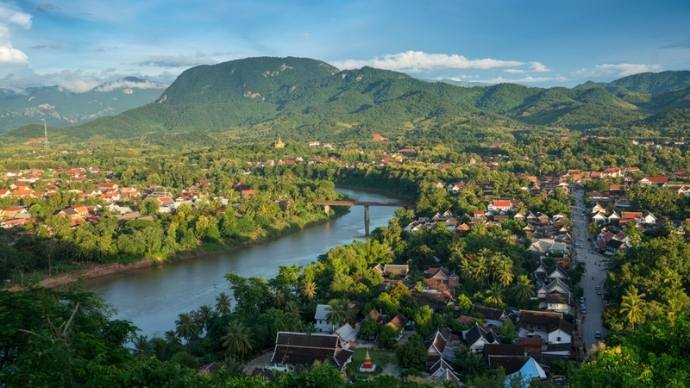
With its orange earth, the fragrance of frangipani, and the clear blue skies, the city of Luang Prabang in Laos, flanked by the Mekong river and its tributary Nam Kahn, feels like a time warp in ways more than one. The main street Sisavangvong is lined with wooden shophouses for souvenirs, cafes, low-rise colonial buildings, and wats or temples. I cross it and dive into a back street to find a parallel universe of old wooden Lao houses with pointed roofs, fronted by gardens and palm trees, and dogs stretched lazily in the afternoon sun.
Luang Prabang founded by a warlord in ancient times, was the ancient royal capital of the Laos Kings, and later, was under the French. The city’s name is derived from a golden Buddha image called the Pha Bang, a gift from the Khmer monarchy, which is today preserved at the Haw Pha Bang, the royal temple. Luang Prabang today is home to a mix of French, Chinese, Burmese, and Lao architecture. A lot of the beautification of the city was a result of the efforts of King Sisavang Vong in the early 1900s.
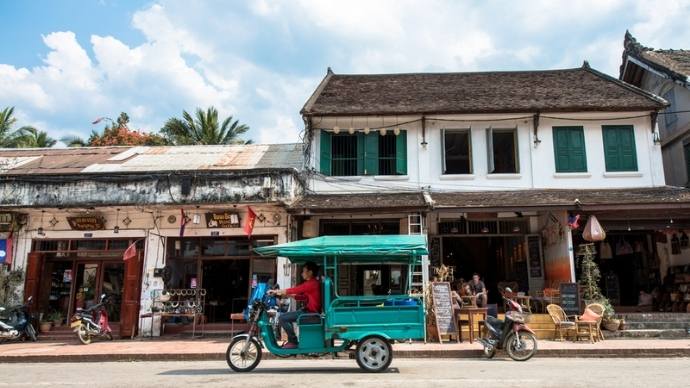
Till the 1980s, the town was just a forgotten Mekong outpost, haunted by few backpackers. Everything started changing from 1995 when it was titled as a UNESCO World Heritage Site for its architecture. New life was breathed into old buildings and townhouses, many of which were turned into heritage hotels and restaurants. Our hotel, a beautiful Sofitel property tucked on one end, has an interesting history, like most buildings in the city. It used to be the French Governor’s residence, and later, was transformed into a detention centre — its watchtowers still stand in mute testimony to its past.
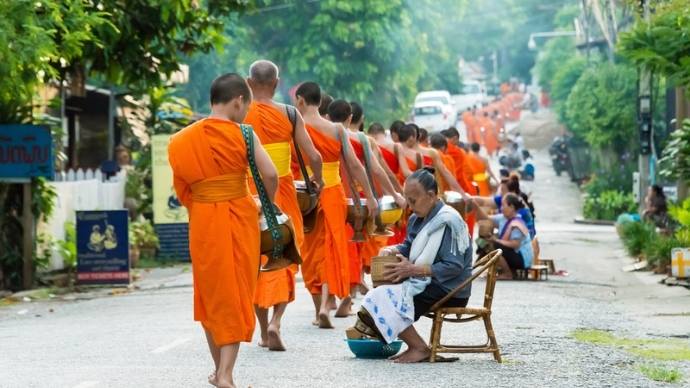
I rise at the crack of dawn one morning, and accompany my guide to the centre of Old Town to see the local custom of Tak baat. Barefoot monks start a walk from their monasteries in a single file, with bowls in hand, receiving alms — usually balls of sticky rice or baked yam — from the faithful. A stunning spectacle in saffron! Small stalls set up in the road selling different offerings to devotees, who sit on mats and stools on the roadsides. Monks of all ages, from young boys to older men, march along after getting their offerings. The rest of the day is spent in prayers and meditation.
We visit the Royal Palace, on the banks of the Mekong, built for the King Sisavang Vong in 1904 during the French colonial era. After 1975, when the royal family was overthrown by the Communists, it was converted into a museum. The architecture is a mix of Lao motifs and French styles with wooden timber floors. In the King’s reception room, there are unique murals painted by a French artist that change with the light at different times of the day! The showstopper of the palace, however, is the Throne Room featuring red painted walls festooned with glittering mosaics made from Japanese glass.
History whispers from each corner of Luang Prabang. The French introduced European building materials and techniques, and executed them with Vietnamese labour, adapting it to the local weather conditions of Laos. Today, the French influence lives on from bakeries that sell fresh bread and croissants, to restaurants serving haute cuisine.
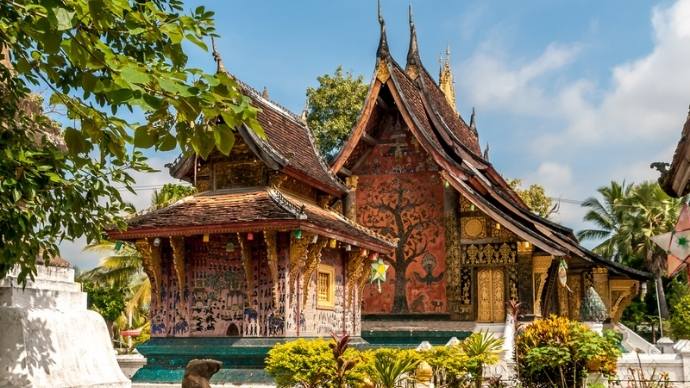
What really makes the town tick is the strong Buddhist influence — there are more than 35 wats or Buddhist temples around town. The most beautiful one is Wat Xieng Thong dating back to 1560, with a huge roof that looks like a bird ready to fly with its wings outstretched. It has the most exquisite glass mosaics in the Red Chapel behind as well as a huge ‘Tree of Life’ mosaic on a wall. Red river serpents, gold stenciling on maroon and black walls, a reclining Buddha, murals of tales from different times — this is a sensory feast for eyes!
My favourite is the lesser-known Wat Pa Phai or the Monastery of the Bamboo Forest, tucked into a side street with glittering gold leaves, mosaics, and a trio of flamboyant peacocks. Don’t miss murals from the life of the Buddha with details derived from the 19th-century Laos’ rural life. What I enjoy the most is the peace and tranquillity of these temples — except for an artist sketching the scene and a few monks sweeping the grounds, I remain all alone to contemplate the beauty.
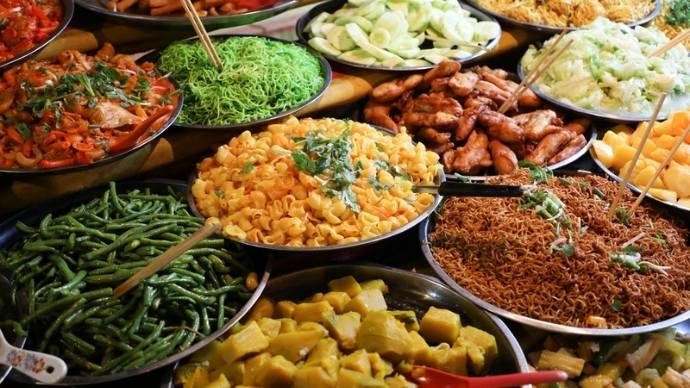
My evenings are spent walking along the Mekong waterfront, lined with mango and jackfruit trees and bohemian bamboo-shack bars with wooden decks overhanging over the muddy river. I end up at the night market that is set up every evening in the centre of the town, with stalls selling tribal wares like bright shawls and textiles, silver jewellery, and pouches of Laotian coffee. Food stalls do brisk business from selling coconut pancakes on hot griddles, noodle soup, and fresh fruit juices. It’s like a fairground full of verve and energy, that goes on till late at night.
To get a glimpse into the sad history of the town, when it was the most bombed country, I spend some time at the UXO Centre. For almost 17 years, it was bombed by both the USA and North Vietnam as it was part of the infamous Ho Chi Minh trail during the conflict between the two countries. More than 270 million cluster bombs were dropped, and many of them, which failed to detonate, remain unexploded in the fields even today causing deaths or maiming people.
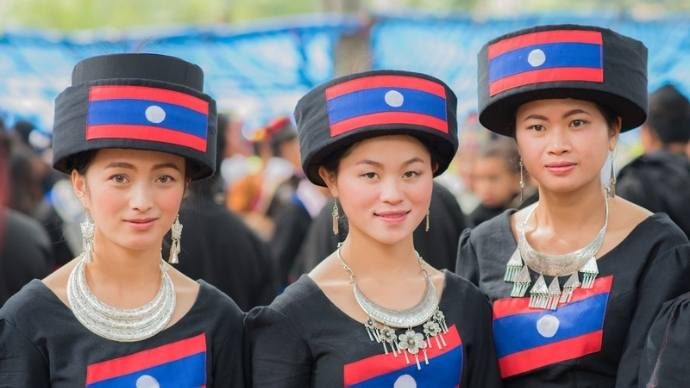
In the hills surrounding Luang Prabang, live tribes like Hmong and Khmu. A great place to learn about their culture is the TAEC (Traditional Arts and Ethnology Centre), which showcases everything from traditional textiles, jewellery, household utensils, musical instruments, to traditional jaw harps, bamboo baskets, and elaborate headgear belonging to different tribal groups.
On the last evening in Luang Prabang, we celebrate my husband’s birthday with a meal at Manda de Laos, a romantic little restaurant with a fairytale ambience, overlooking a pond stocked with carp and water lilies. The property has been with the family for three generations and the lotus ponds are a UNESCO Heritage Site! We feast on traditional Laotian food like neam khao (a Laotian crunchy rice salad) and vegetarian laap (tofu mixed with rice powder and herbs and crunchy coconut rice). The magical ambience seems the perfect way to end our Laotian sojourn.
Read more.
A whiff of Vietnam in the coasts of Mumbai at Nho Saigon
After a long gap of 21 years, Cyprus to reopen sea-link with the outside world