
We interview acclaimed author William Dalrymple, a historian, presenter, podcaster, and thinker, who has been demystifying destinations for decades, to find out what travel means to him.
William Dalrymple is a luminary in the fields of literature and history, whose extraordinary work has informed and inspired Indians curious about our own country’s culture and past. Born in Scotland, he ‘discovered’ the delights of India in January 1984 and has been one of the most prominent Indophiles ever since, spending the better part of the year at his Mehrauli farmhouse on the outskirts of Delhi.
A prolific writer, Dalrymple has authored a plethora of books that cover a diverse range of topics, from the legacy of the British Empire in India to the politics of the Middle East. His work has garnered universal acclaim from critics and readers alike and has earned him numerous prestigious accolades, with every one of his books receiving recognition.
Images: Courtesy William Dalrymple.
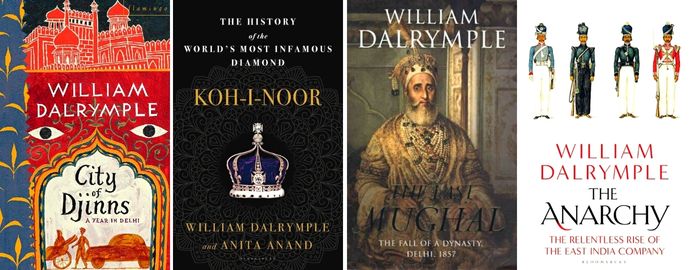
One of Dalrymple’s most notable early works on India is City of Djinns: A Year in Delhi, a poignant memoir that offers a personal account of his experiences living in Delhi for a year. This book is a testament to Dalrymple’s prowess as a travel writer, blending history, memoir, and travelogue into a breathtaking narrative that captures the essence of Delhi, a city that is both majestic and intimate. Third cousin to the Queen Consort Camilla, he has also co-authored a book about the much talked about Koh-i-noor diamond! His recently concluded Company Quartet — comprising White Mughals, The Last Mughal, Return of a King, and The Anarchy — has been hailed as one of the most moving and comprehensive collections of writing around the Raj. With meticulous attention to detail, Dalrymple paints an evocative picture of this tumultuous period in Indian history, drawing on a rich array of sources to create a compelling narrative.
He was also writer and presenter of India-inspired television series in the UK (Stones of the Raj in 1997, Indian Journeys in 2002, and Sufi Soul in 2005) and was historical consultant to the more recent (2019) series called Beecham House on OTT. Keeping up with the times and trends, Dalrymple collaborated with journalist Anita Anand (with whom he had co-authored the book on the Koh-i-noor) to create a podcast called ‘Empire’ last year, focusing on the British rule over India and the years preceding it as well as the conditions immediately post-Independence.

Image: Courtesy Beecham House.
Author, historian, podcaster, photographer, art historian, curator… Dalrymple wears many hats with élan. Co-founder of the world’s largest writers’ fest, the Jaipur Literature Festival, he is also a leading public intellectual, whose commentary on wide-ranging topics has earned him a reputation as a thought leader of the highest calibre. With a vast body of work that spans multiple platforms, Dalrymple is a truly exceptional figure, whose insights into the human condition are as profound as he is accomplished.
Although master of many disciplines, the writer’s core expertise has always been about dissecting a destination, analysing its anatomy to find how its history, geopolitics, and culture have made it what it is. In his interview with TravelDine, William Dalrymple talks about travel as a personal passion, as an arrow in one’s writing quiver, and as a tool to trace the world’s histories…
Everyone’s a travel writer these days. How do you define what writing on travel is and how it’s evolved?
Everyone’s always been a travel writer. In the old days it was diaries and postcards and letters and now it’s online blogs, but to me, fine travel writing is a great art and, as you know, not every novelist is Tolstoy and there’s every level of sophistication up to that peak. It’s perfectly legitimate to be an Instagrammer writing in millennial speak! Over the years we’ve had all the great travel writers in the world — VS Naipaul, Peter Hessler — some astonishing writers. So yes, I think, like anything when it’s well done it’s a high art form, but it’s also something that anyone can enjoy. Just like with photography, anyone could take snap, but a mobile phone picture doesn’t mean you’re Raghu Rai.
But how would you define good travel writing?
It’s a matter of personal taste and what I consider to be great travel writing is different what from what other people may. My personal favourite writer is not well known in India, a guy who was my great hero for many years — Patrick Leigh Fermor. If you haven’t read him and you’re interested, download A Time of Gifts and do yourself a favour. Likewise, Bruce Chatwin (In Patagonia), Redmond O’Hanlon (Into the Heart of Borneo), Robert Byron (The Road to Oxiana) these are great, great books that that gave me such pleasure.
For myself, travel writing is something I read in my 20s when I was more fleet of foot. Now, middle-aged, I’ve got three kids, a mortgage, blah blah blah and so I don’t do the sort of trips I did in my 20s, where I set off in May and came back in October and was on the move the whole time. Now it’s often weekends or weeks away. But last year I had one of my favourite trips ever to Cambodia, wonderful country unforgettable, and also to Indonesia. Books give you a very good excuse to get away and travel.
Through your own writing you have literally taken people across the length and breadth of India. There’s so much travel that you have undertaken. You first came here in 1984 and within five years you were actually living in India. But when you first started travelling across the country, what was the one place that maybe sparked that interest in it?
I remember arriving at dawn off a bumpy night bus at Mandu in Madhya Pradesh. I suppose it was a February morning with that slight cool in the air and driving up that great gorge up onto the plateau of Mandu, seeing these astonishing ruins falling into decay with you know beautiful walls encircling the hills and palaces that looked like they were out of some 19th century explorer’s book… I knew that Lord, I’m lost to this country now and there’s no going back! And that evening, standing on the parapet and watching the fruit bats come like a black army of vampires or something overhead and that I remember was the moment I was lost to India. I’m really still on that year off now (laughs)!

That’s wonderful! You’re so familiar with so many languages, Urdu, Persian, and you also look up historical records for your writing… Your own ancestors were part of key moments in Indian history. You’re so deeply immersed in the country… How do you separate yourself from the subject when you’re writing?
Well, travel writing is entirely subjective. I wouldn’t claim for a minute that any of my travel writing was objective or even pretended to be. It’s a personal, one man’s view. With history you do try and distance yourself a little but your opinions of course will always show and you can always tell pretty quickly for the historian whether they’re from the left or the right whether they’re whether they’re — in terms of Indian history — massively pro-Mughal or massively anti-Mughal! Historians may try to be objective, but within a few pages, you can see their prejudices shine through.
This is fine but the reader has to be aware of it. I think, in a sense, it makes for a good historian when you can tell their enthusiasms which is the B side of that… You can tell when things are really lighting him or her up and that’s the moment of ignition that brings the reader in and makes the narrative come alive.
Spectator has listed you as among the world’s top thinkers just a couple of years ago. And while travel can be physical or through archives, but it can also be a very mental thing. When you’re conceptualising a book, how much of the travel is just internal?
I think if you’re travelling to write rather than just travelling for relaxation or to escape from the tedium of home or whatever it is, you need to prepare yourselves, you need to educate yourselves on what you’re about to see. We all travel in a degree of ignorance whenever we go to somewhere new and that’s the excitement of it, where you fill in the gaps and you begin to understand the place.
But, if you can read some good travel book, like say last year I went to Cambodia and for the previous six months I’d been reading about Angkor Wat and the civilisations. and it completely changed my understanding of what I saw. Rather than just magnificent piles of stone, to understand that these were Hindu temples or Buddhist monasteries and that they came from the extraordinary hydraulic civilisation where the cultivation of rice allowed vast numbers of people to gather in one place and then create one great urban environments of history.

But there’s a strange sort of thing with travel writing… On the one hand you need to have the eye of someone that’s just dropped in, you need to have those vivid first impressions that a newcomer can bring to something. Because you see things you don’t see at home. For example, you going to London will see the red pillar boxes and double decker buses which are just every day to me. So you need that, but you also need a degree of understanding to interpret what you see and if you arrive completely dropped off the moon in a place without any knowledge, you won’t understand what you see. So, it’s about getting that balance right, I think.
That’s definitely a fine balance! Meanwhile, your photography has suddenly taken off in a big way, you’ve had photo exhibitions in London and even in Delhi a few years ago. I’m sure you’ve always taken the photographs but what suddenly spurred having exhibitions? And your wonderful feed on Instagram…
Thank you! I love photography and it was very much part of my childhood and youth. A school, I was a photographer that’s what everyone knew me as. I always had my camera and would come out of the dark room stinking of fixer and developer. Your generation will not understand what that means but in the old days when we used chemicals, you could immediately tell when someone had been printing a photograph, because you smelt of fixer, a very pungent and acrid smell. And it was the discovery of editing tools like Snapseed, the free app from Google that made me realise that you could recreate the black and white pictures from the dark room very quickly on your phone.
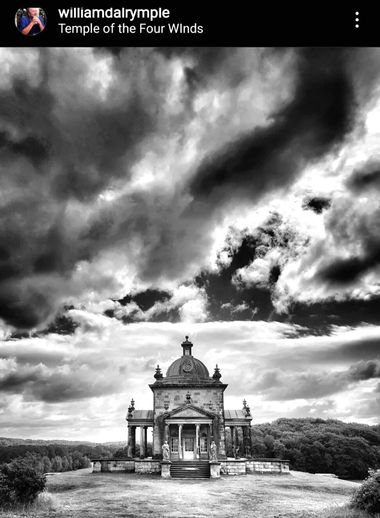
I’m not a photographer, I’m very much an amateur and a writer is what I am. But I love taking photographs and it uses a different bit of your brain and, you know, writing is a very slow process where you write, rewrite, edit, rewrite again… Photography is of the moment, it’s instant. If you miss that instant, it’s missed forever. And visual, so it complements writing very well. When I’m researching one of my books, I take lots and lots of photos. I wouldn’t claim for minute to be a serious photographer. In fact, I’m taking more on my mobile phone these days although I have a lovely contact SLR, it hasn’t left the cupboard for two years!
Now do tell us a little more about The Golden Road, your next project…
The Golden Road is a departure for me because I have finished the Company Quartet that kept me going 20 years. For the last 20 years, I’ve been immersed in the 18th century and the story of this bizarre tale of how one London corporation in one office block took over the richest country in the world, which is an unprecedented historical story.
In fact, I even have a podcast called Empire and that has over a million downloads a month. So, anyone that’s interested or has enjoyed my history books or is interested in history of the Raj, the East India Company, the British Empire in India, Partition, freedom struggle, all these sort of subjects, will find much fodder on Empire Pod.
But now, I’ve now got back to my first love, which is art history and archaeology. The Golden Road is all about how India’s spiritual, cultural, artistic influence radiated outwards. So, one is the story of Buddhism going up through Pakistan and Afghanistan to China. Part Two is the maritime route to Southeast Asia and how Hinduism and Buddhism both travelled along that route. The largest Hindu temple in the world is not in India but in Cambodia. And then finally, the story of how Indian numbers, astronomy, and mathematics went westwards, first to Baghdad and then to the West. That we use what we call in the West Arabic numbers, but are in origin, Indian number. You know that, but people in the West don’t!
William Dalrymple’s travel wish list
- A place in India that he’s most fascinated by, apart from Delhi, Agra, and Jaipur: Chamba in Himachal Pradesh. Gorgeous! I love those hills, particularly in summer.
- A place in India that he hasn’t been to yet, but would like to visit: I’ve been to most of India, but there are still places in the northeast that I’d love to see more of, particularly Arunachal.
- Globally, places he’d like to visit, other than Lahore and Scotland:
- I’ve got great chunks in the world I haven’t seen! I’ve never been to Latin America, huge areas of Africa, Eastern Europe, and Russia. There’s lifetimes of travel ahead still. There are so many places I really want to see badly, like probably Machu Pichu. But one of the great places that I love and haven’t seen nearly enough of and plan to go back to when possibly can is Persia. Once the revolution there is over, I’ll be back in a flash.
In his first book In Xanadu, a travel tome published in 1989, a young Dalrymple had traced the path taken by Marco Polo from the Church of the Holy Sepulchre in Jerusalem to the site of Shangdu, famed as Xanadu in English literature, in Inner Mongolia, China. He had written about his experiences in revolution-torn Iran (modern-day Persia) while on this voyage of discovery. It’s not surprising that the author’s journey has almost come full circle today.
Read more.
City Walks: The sensational sensorial symphony that is South Srinagar
William Dalrymple on the JLF: ‘That books can be performed publicly is an idea this country is friendly with!’