
In the third of our City Walks series, we explore the bustling markets and serene shrines of neighbourhoods whose origins date back two millennia.
There’s a Srinagar beyond the scenic Dal Lake and the beautiful Boulevard that rings it. If, like me, you’re determined to see more than the touristy spots, take a walking tour with a city expert.
The dynamic and well-travelled Altaf Chapri, owner of the sumptuous Sukoon houseboat where I’m staying in Srinagar, understands my need to go deeper than the delightful sights. He arranges for me to meet Nisar Malik, who has been conducting bespoke guided tours for visitors to Kashmir for almost 14 years. A relaxing journey by shikara followed by a short drive and we are on the banks of the river Jhelum, ready to explore a very different side to the city.

Starting at the historic Zaina Kadal, an ancient bridge constructed by Sultan Zain-ul-Abidin, known as ‘Badshah’ almost 600 years ago, we see the Muslim shrines and tombs as well as the Hindu ghats and temples here.
We walk around the area known as Maharajganj, name so as it was started by the Dogra king Maharaja Ranbir Singh in the 19th century. While the area around Lal Chowk is considered the bustling city centre of Srinagar today, this market used to be the main hub for the trade of wholesale goods before the newer ones came up. Frequented by traders from Amritsar, Lahore, Karachi, Rawalpindi and parts of Central Asia before Partition, it was a centre of commerce and a stock exchange of sorts at the time.
Today, watching the copper artisans at work here is fascinating. They add a coating of tin to the inside of ornate plates in a process called ‘qalai’, so that people can safely use them for daily meals, including sour ingredients.

Malik tells me that traditional Kashmiri households use a lot of copper utensils. Seeing the brisk sales of samovars and other vessels done by the shops selling these, it seems the practice is still very much in place.
I spend a delicious morning conversing with indulgent and affable vendors. Here is a smiling gentleman who sells spools and spools of exquisite silk thread. Further down the road is a woman keen to chat about the scope for selling her copperware in Mumbai. A family proudly shows off their furniture made from reeds grown on the periphery of the lake, inviting me to sit and enjoy a glass of kahwa with them even though I’m clearly not a buyer. Gracious hospitality is in their blood and I’m more than pleased to partake of it.
Shrine shine
There are many interesting shrines — both Hindu and Muslim — coexisting peacefully in this historic area. We stop by the Shah-e-Hamadan mosque, as it has some fascinating architecture and is tied to the arts and crafts of Kashmir. It was built in 1395 AD to commemorate the influence of Persian mystic and reformer Mir Syed Ali. He visited Kashmir three times between 1365 and 1383 AD, introducing Islam and Persian crafts to the people of the valley.

Its wooden architecture, with ceilings and walls decorated with intricate papier-mâché, make it more than a religious structure. Even after three fires and rebuilt many times, the most recent structure erected in 1731 AD has some stunning work that I find compelling in its beauty as well as symbolism.
The glorious white dome of Hazratbal glimmers on the edge of the Dal Lake, beckoning to the faithful as well as those seeking beauty. In the sonorous Naat or Durood that emanates from its interiors, there’s a sublime serenity of worship that is palpable even to me, who has a sketchy relationship with the divine.
To market, to market
Having filled our souls with the meaningful monochrome of dome and lake, we go over to the market surrounding the Hazrat Bal shrine for some local colour. As it’s a Friday, the Srinagar locals are out in full force, buying fresh vegetables that have been brought over by shikara, a vast variety of lentils, fish, spices, as well as loose tea leaves from Darjeeling for their salty noon chai.
As we walk around, Malik introduces us to the local snacks, from healthy steamed and spiced lentils to the most binge-worthy deep-fried parathas sold with sinfully sweet ghee-laced semolina pudding by halwais who moved here from Uttar Pradesh 30 or 40 years ago. People buy these for their family on the way back from prayers at the mosque.
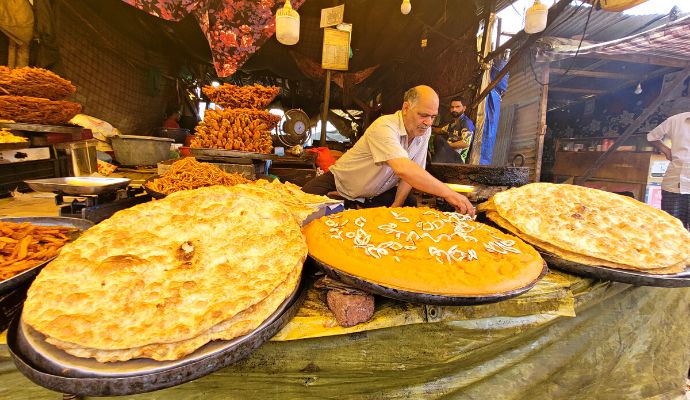
It’s a very affordable moveable feast, with pickles by the kilo, wazwan meals to be had from streetside stalls, and freshly baked breads of many types spilling out from old-school ovens for a song.


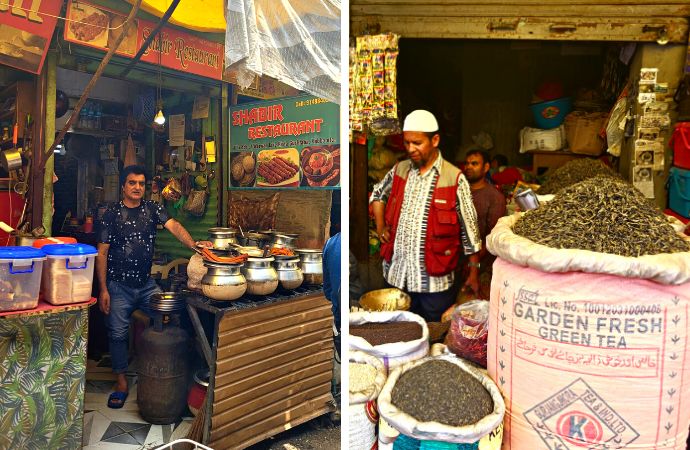
Our city walk is the first step in the exploration of this fascinating city. Malik tells us there are seven magnificent bridges to look at, beautiful architecture of old houses to appreciate, a host of fascinating people to meet, and a lot more in store.
Read more.
TravelDine 60 Hours: The beauty and bliss of Srinagar
Following the papier-mâché trail in Kashmir
We discover all kinds of delish at Le Delice patisserie in Srinagar!