
We take you to Kutch in Gujarat to meet a family that has preserved and promoted Rogan Art, the rare form of painting on fabric, for four centuries.
As I walk in the narrow lanes of the village of Nirona in Kutch in Gujarat, a group of kids start to accompany me. “You must be looking for the home of Abdul Gafur Daud Khatri. Have you come to see the live demonstration of our unique Rogan Art?” one of them asks me in Gujarati.
As I nod in agreement, the kids lead me to the Khatri house. The family has been keeping alive the remarkable art form of Rogan for the last eight generations. They have single-handedly not just carried forward this legacy but also put the art on the world map. Exclusively done in India in Nirona, Rogan was presented by PM Narendra Modi to erstwhile US President Barack Obama.
I am warmly greeted by the humble and immensely talented Abdul Gafur Daud Khatri who won the State Award in the year 1988 and the National Award in the year 1997 for Rogan Art. He has also won the Padma Shri and is the first artist from Kutch to be awarded for his handiwork.
What exactly is Rogan art?
Before he begins the demonstration, he offers an introduction to Rogan Art. “It is Persian in origin. Rogan means oil based and is prepared by heating castor oil to boiling point over a period of two days. It is cooled on the third day and has a glue-like consistency. Natural colours are then mixed into it,” he explains, as he takes an instrument that resembles a pencil. It is made of steel and works as a brush.
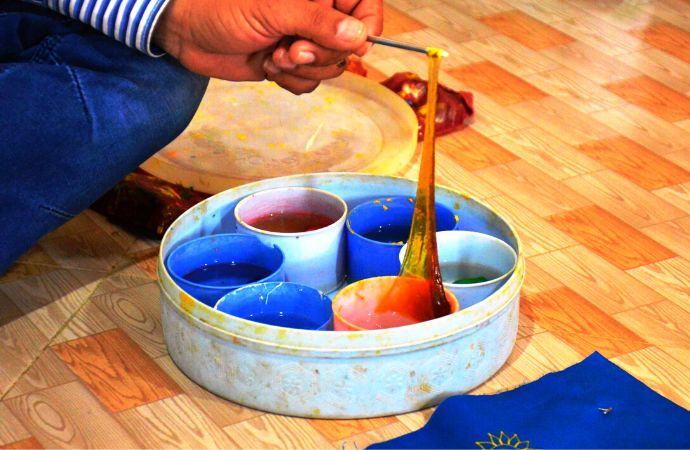
Traditionally, there are five colours that are used. These include green, blue, yellow, red and white. With the passage of time, pink was also added to the palette. I notice that the colour pastes in front of Khatri are immersed in water. When I enquire why, I am told that this serves the dual purpose of keeping them moist as well as preventing any dust from accumulating on them.
Abdul then takes the mix which is in the form of lumps and rolls them on his palm using the pencil. “My brother is doing that because when the mix comes in contact with his body temperature, it makes it easier to draw the designs on cloth. They look more even, and we are able to use them more smoothly,” adds Sumar Daud Khatri, who won the National Award in the year 2003 for Rogan Art.
Cotton cloth is mostly used for rogan. Before the design is drawn, the piece of cloth is folded in half as the design is only made on one side of the cloth. No form of tracing is done in this art, so the designs created depend on the skill, imagination, and experience of the artist. There is no frame to support the cloth either, hence Abdul uses his finger to support the design while he paints.

After completing the design, the other side of the cloth is pressed on it so that a mirror image emerges. Post that, the cloth is dried in natural sunlight for four hours. This ensures that the waterproof colours are firmly fixed. Floral motifs, animals and oriental architecture are popular designs that can be seen in this labour-intensive and time-consuming art.
How the Khatris of Kutch have kept the tradition of Rogan art alive
When the family started creating Rogan Art, it was primarily for the local community and consisted of traditional designs. “Our grandfather recounted stories of how he had a lot of orders during the marriage season as he made Rogan on ghagras and dupattas worn during marriage ceremonies. Other than that, rogan was done on pillow and mattress covers. With the advent of synthetic and printed fabric, our family did see some hard times. It had reached such a stage where we were going to give up this art. Somehow, we pulled through by selling vegetables,” narrates Sumar.
The time taken to create each handmade piece depends on the intricacy of the work involved. Sometimes, a square foot of cloth can take up to a month. “It has taken me a year and a half to prepare a single wall hanging,” recounts Abdul. “We try to achieve perfection with every painting but, at times, because it is so perfect, visitors mistake it for a print made on a machine rather than by hand!” laughs Arab Hasham Khatri, who won the state award for Rogan Art in 1991.
How Rogan art has evolved
Over the years, the art has been refined. The earlier designs were rustic in appearance and the lines that were used to make them were quite thick. Sometimes, these lines were as thick as a human finger. The Khatri family’s improved finesse can be seen in the current pieces whose lines are as fine as a single strand of hair.
Not just the designs, even the variety of products has diversified. From making it on stoles, salwar kameez, bags, and purses, Rogan is now created on pillow covers, cushion covers, and mattress covers too. Once the demonstration is completed, I am shown a range of products prominently featuring Rogan Art. An intricate tablecloth catches my eye from under the mobile pouches that are placed in front of me.

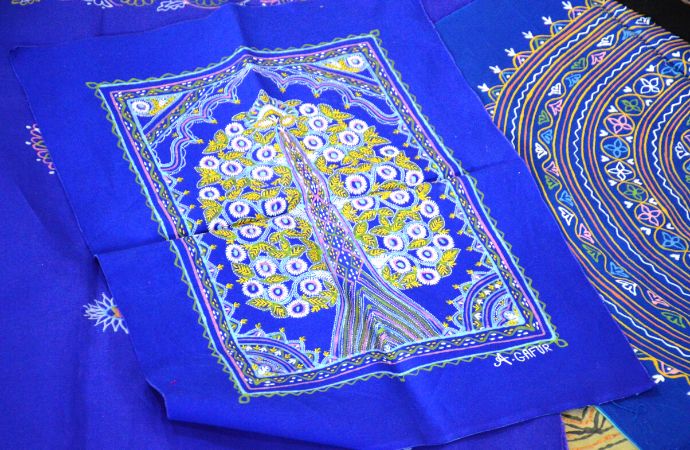
Saving the best for last, Abdul shows me the piece de resistance of Rogan Art, which is the Tree of Life. It is a tree painted with intricate branches that can be framed as a wall hanging. The lines are so fine that, instead of a painting, it is often thought to be embroidery.
The eighth generation to carry on this craft, it has been 400 years since the family has kept Rogan alive. With expanding tourism and travelers realising the value of handmade souvenirs, awareness is being created for this eco-friendly craft. “It is heartening to see tourists come and enthusiastically see our live demonstrations at our home. Many of our customers keep our pieces as collector’s items. This motivates us because this art is in our blood,” say the Khatris.
Read more.