
Goa’s bread whisperer Sujit Sumitran talks baking, fermentation, and the math of making sourdough.

The year was 2020. In the middle of a pandemic, people found themselves stuck at home, with time on hand to dedicate to cooking experiments. It was a time that saw the rise of Dalgona coffee, focaccia gardens, banana bread, and, of course, sourdough. This ancient form of breadmaking appealed to people who found themselves going back to their roots when it came to food.
Sourdough’s virtual popularity
Back in Goa, Sujit Sumitran was bemused with this sudden popularity of sourdough. A sourdough proponent and self-taught baker for over a decade, he was suddenly besieged with calls seeking advice about sourdough.
Sumitran — is known by many as the sourdough whisperer — has been championing sourdough bread through offline classes, workshops across India, and on social media over the last few years. Before the pandemic, Sumitran would open his Goa home to sourdough enthusiasts, who would spend a day learning the intricacies of the bread, help make it, and then eat the fruit of their labour.
Watching so many people get curious about sourdough, he decided it was time to take his course online. A collaboration with flour company TWF Flours meant people could pay for the course and get specialised flours to try baking.
He hasn’t gone back to in-person classes. “The objective of the workshop is to get people to bake their own bread and the online one is turning out to be far more successful,” he says. In addition, with two older folks at home — his mother and wife Sudha’s mother — he is unable to travel as much. The main reason, though, is because his baking process has changed.
“When I started out, I used to make bread which was mostly maida with 20 per cent whole wheat flour. Now, everything I bake is completely wholegrain and it has changed the baking schedule. I start in the evening, work on the dough for three hours, then put it away in the fridge for a slow fermentation process, and bake it early the next morning. Totally, it’s a 15-hour process, which is impossible to do in one day with people,” he says.
The many ‘firsts’ with sourdough
He attributes the success of the online class to the fact that it is easier to learn something new when you do it by yourself. “It’s when you make mistakes and learn from them. You can see what you are supposed to do, repeatedly, before you actually do it. Earlier, I would give participants the starter. Now, they make it themselves. I’ve observed that very quickly, in three to four attempts, people are coming up with professional-looking loaves.”
He does miss the in-person workshops: “It is fun to spend time with people you’ve never met and have a meal with them.” Beyond the conversations with people, he enjoyed watching people score the bread (slash it with a blade before putting it in the oven). “Indian cooking doesn’t have anything of that sort… It used to be a first for many,” he explains.
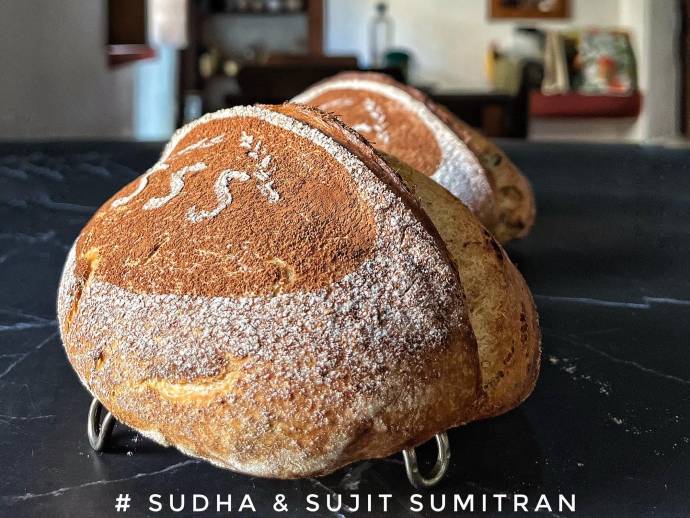
In actuality, the sourdough workshops ticked off other firsts for people, too. “We don’t use an oven so much in Indian cooking. In sourdough, you need to bake at high temperatures for a shorter period of time. It takes some time to understand your oven and you need an oven thermometer to check the actual temperature.”
Sumitran’s tryst with baking bread began when he bought a bread machine for Sudha, but then couldn’t keep himself away from it. He experimented with it for months before turning his attention to sourdough. He started with maida initially, before moving to specialised flours about five years ago (a favourite is Flour X, a special wholegrain flour blend from TWF Flours).
The many mysteries of sourdough
Sumitran’s research into breads and flour occurred when he switched from maida to wholegrain flour. Listening to him talk about sourdough starters and Symbiotic Colony of Bacteria and Yeast (SCOBY), it is evident that baking sourdough isn’t only about the flour, or hydration, but is a question of math. For instance: Consider your starter is made with wholegrain. If making maida-based breads, you have to add 20 per cent of the starter; if it’s wholegrain, then it is only 15 per cent as wholegrain ferments faster. And, Sumitran adds, as millets don’t have gluten, you should add only about 5-10 per cent of it to the bread.
It’s a constant learning process. It is why he regularly posts his baking experiments on social media, mentioning hydration (amount of water), the flour used, ingredients added and when, the coils (folding and stretching of the dough), and whether they’ve been painted. It’s a good set of guidelines for those seeking to do something similar.
Over the years, he has used hemp — “it gives a lovely dark green colour and distinctive flavour”, purple corn, and activated charcoal. Brined peppercorns, Californian prunes, shallow fried ginger juliennes, oranges, chillies, blueberries, black garlic and caper spread, prunes, cocoa, coffee, black pepper, hemp seed powder have all gone into the folds. Once, he even added in Cadbury gems: “It was a hit with the children who were visiting.”
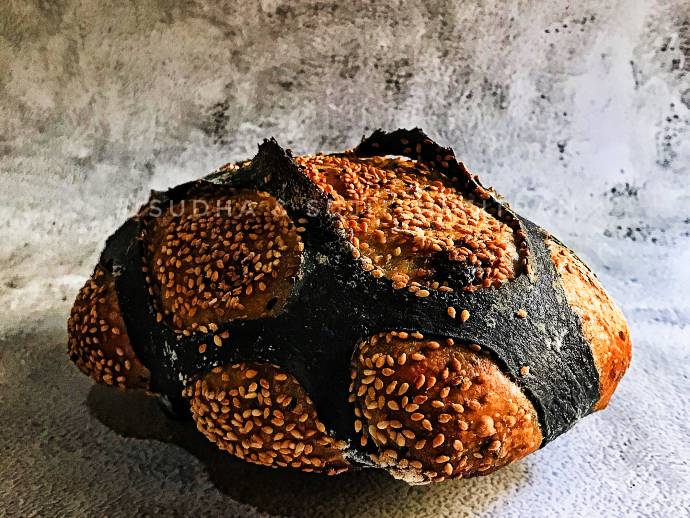
Sometimes he makes enriched loaves with eggs, organic jaggery, milk, virgin coconut, and pink salt or enriched potato buns with potatoes, milk, black coffee, liquid jaggery, egg, and extra virgin coconut oil. Each experiment is a chance to learn something: “Oil doesn’t let the crumb open up as much” or “using eggs makes the crumb soft and brittle”.
The systematic science of sourdough
The biggest challenge he has come across as a sourdough teacher is that most people assume the flour used for chapatis is good enough for bread. “A lot of people are unfamiliar with the basics of bread-making. For bread, you need flour milled in a particular way, and gluten that is unfettered.”
It’s why he recommends sourdough to people who talk about gluten intolerance. “The issue isn’t only gluten. The bread you get in the market uses a lot of commercial yeast so that in a short period of time, it rises very fast. The gluten doesn’t get a chance to dissipate, so, you eat all of it. Commercial bread only has commercial yeast, sourdough has yeast and lactic acid bacteria. If you consume slow fermented sourdough bread, the gluten is broken down, so it is easier to digest.”
Sumitran hasn’t eaten too much sourdough outside — “I make it at home when I need it”. Like a proud teacher, he will readily talk about the people who’ve learned about sourdough from him and are now baking and sending him pictures of it. Interestingly, his daughter-in-law Priyanka Sardessai (of the fabulous Larder & Folk in Panjim) was one of his first students.
“To bake sourdough, you have to have the right frame of mind and be systematic. It’s not so much work and is quite simple once you get the hang of it,” he says. “Once you do, you can just wing it.” Cadbury gems sourdough, anyone?
Visit https://twfflours.com/baker/sujit to access the course. Instagram
Read more.
Bread and bakeries, North Goa’s love affair with all things doughy