
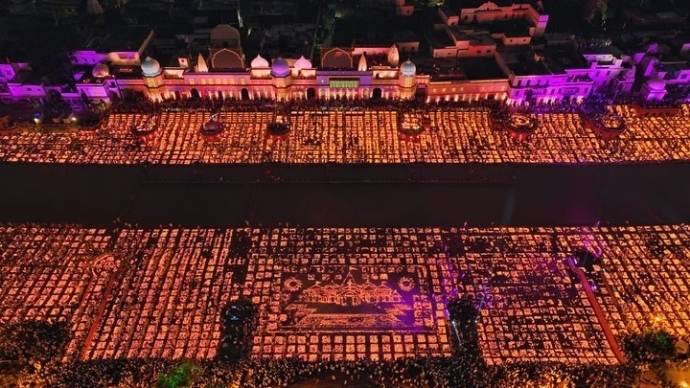
With over 15 lakh diyas, laser exhibitions, and fireworks illuminating the holy ghats of Ayodhya, Deepotsav 2022 was a grand and record-breaking affair.
It is a dream for devotees to celebrate Diwali or Deepavali in Ayodhya. Under the guidance of Chief Minister Yogi Adityanath, the Government of Uttar Pradesh organises the grand Ayodhya Deepotsav every year to mark the homecoming of Lord Ram to his birthplace. This year, the grand celebration made the world stop and take notice.
Inside Ayodhya Deepotsav 2022: A record to remember
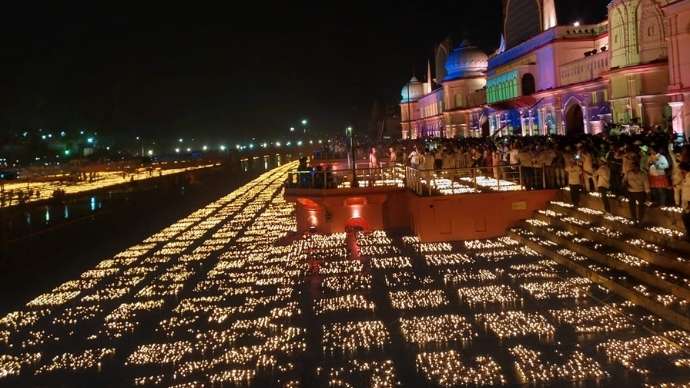
On October 23, Ayodhya was bedecked for Deepotsav 2022. The grand celebration was held on ‘Choti Diwali’ at Ram Ki Paidi on the banks of the revered Sarayu River. A grand aarti was performed following which the diyas were set afloat in the sacred river.
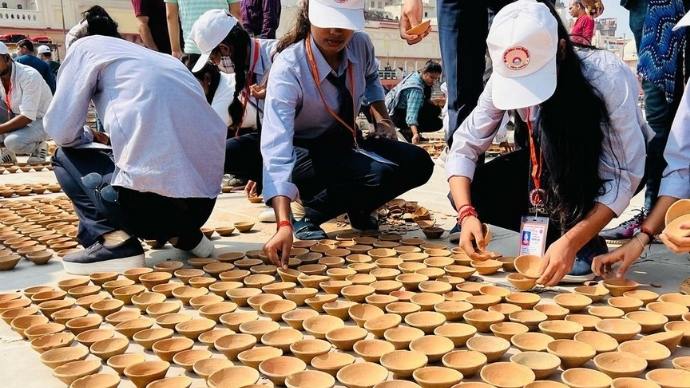

The holy city entered the Guinness Book of World Records for lighting up over 15 lakh diyas (earthen lamps) during the sixth edition of the celebrations. It took over 19,000 volunteers to illuminate the ghats within 40 minutes, the specific time frame mandated by the world records firm. A total of 15,76,000 earthen lamps across 37 ghats of Ram Ki Paidi were lit. The ones that remained lit for five minutes or more were considered for the record. Drones were used to record the proceedings.

Guest of Honour at this glittering event was honourable Prime Minister Narendra Modi, accompanied by over 5,000 devotees, who witnessed the historic moment along with him. “Today, Ayodhya is divine with lamps, grand with emotions. Deepavali lamps are the living energy of India’s ideals, values, and philosophy. Lord Ram gives light to the whole world… He is like a beacon. We begin our celebration with the declaration of ‘Satyamev Jayate’; this celebration will revive the ethos of cultural India,” PM Modi said, addressing the crowds.

As the pristine waters of Sarayu mirrored the glow from the diyas, Ayodhya rose in unison, the chant ‘Jai Shree Ram’ filling the air with the spirit of devotion and celebration. Post the Deepotsav programme, a 3D holographic projection was also installed to screen a few crucial episodes from the epic Ramayana. Apart from the spectacular oil lamp lighting, Deepotsav 2022 featured laser exhibitions and fireworks, creating a dazzling virtual display in the skies of Ayodhya.
All about Ayodhya — a tale of faith and devotion
Through the years, immersive spiritual journeys have put India’s mythological heritage front and centre. Ramayana, one of the two of our oldest and ever-enduring epics, has naturally spurred the most intrigue and interest amongst global travellers. And although Lord Ram travelled across the subcontinent leaving an imprint in lore and stone, Ayodhya is where his journey began.
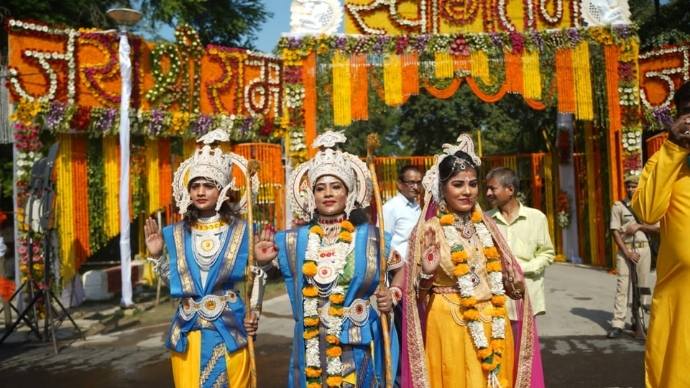
Surreal in its spirit and simplicity, Ayodhya rises like a dream on the bank of the revered Sarayu River, east of Faizabad in Uttar Pradesh. Also called Oudh or Awadh, it is Lord Ram’s janmbhoomi (birthplace) and is counted among the seven sacred towns for Hindus in India. So, no surprise that there are scores of temples dedicated to him across the city.
As per Ramayana, Ayodhya was the affluent and well-fortified capital of the Kosala kingdom during the reign of King Dasharatha (Lord Ram’s father) in traditional history. Scholars also believe that the city is the same as Saketa, the town where the Buddha is said to have lived for a while. Chinese Buddhist monk Faxian stated in the fifth century CE that there were 100 monasteries there, indicating its importance as a Buddhist centre as well.
Spiritual sites in Ayodhya significant to the Ramayana
Ram Janmbhoomi: Lord Ram’s birthplace is a highly revered site. PM Narendra Modi laid the foundation stone for the grand Lord Ram temple in August 2020. The proposed design of the temple is grand and magnificent, with a 251-metre-high statue of the deity.
Ram ki Paidi: This is a series of ghats situated on the banks of the Sarayu River. There is a belief among the devotees that bathing at one of these ghats washes away one’s sins. The riverfront brings forth a majestic landscape, glittering under a full moon.

Hanuman Garhi: It is Ayodhya’s most popular temple, and you climb up a staircase of 76 steps to reach the intricately carved entrance. Inside, there’s a cave with an inner sanctuary where an idol of a new born Hanuman sits in the lap of his mother Anjana Devi.
Kanak Bhawan: Located in Tulsi Nagar, the ‘golden palace’ is a sacred location specifically dedicated to Mata Sita. In the sanctum sanctorum or the garbagriha, three golden-crowned idols of the two deities rest under an ornate silver ceiling.
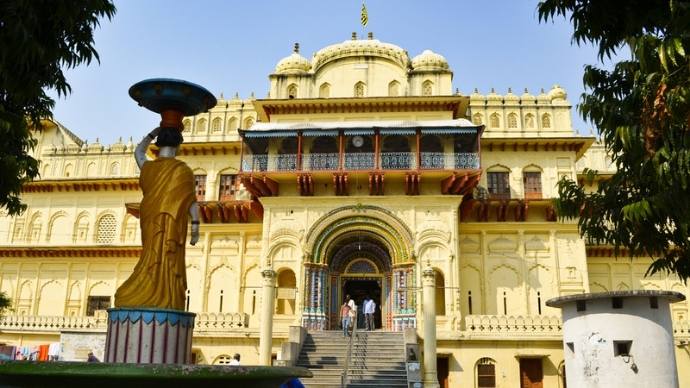
Dasharatha Bhavan: Nestled right in the heart of the city, this temple is constructed at the very same spot where the original palace of King Dasharatha existed. Dasharatha Bhavan houses a shrine with idols of deities Lord Ram, Mata Sita, and Lakshmana. Witness sadhus and saints clad in saffron, reciting dohas and chaupais from the epic and other scriptures.
Treta Ke Thakur Mandir: The 300-year-old temple houses numerous idols including that of Lord Ram, Mata Sita, Lakshmana, Hanuman, Bharat, and Sugreev. Each of these statues is believed to be sculpted out of a single black sandstone.
Read more.
These heritage hotels across India are your best bet for a glittering Diwali getaway!
Diwali 2021: Ayodhya included in Delhi government’s free pilgrimage scheme!