
The mysterious lake in Maharashtra’s Buldhana district is worth a visit. Here’s why.
Lonar Lake looks just like any another land-locked water body. Until you look carefully and realise just how symmetrically it’s shaped throughout. When you walk along the path on 1.8-kilometre periphery of its rim as we did, you’ll encounter everything from ancient temples to dancing peacocks and pack mules.

Five fascinating facets of Lonar Lake
The almost-surreal landscape around the 500 feet deep lake has relatively few tourists, and, on a breezy day, you could even imagine you’re walking around on another planet! And in fact, a 2019 study conducted by IIT Mumbai apparently found that the minerals in the soil here show similarities to the minerals found in moon rocks.
So, forget Brazil, head to Lonar Lake! We aren’t talking beaches and bikinis here, but basaltic impact structures created by meteorites on earth. Of the four that exist on our planet, three are in Brazil and one in India, which is — you guessed right — the Lonar Lake, a notified national geo-heritage monument.

Here are five facts you probably didn’t know about Lonar Lake…
Its history: Ancient is an understatement
The Deccan Plateau, which is made of volcanic basalt rock, dates back to over 65 million years ago. Scientists believe the crater that forms Lonar was created on the plateau by a meteorite from outer space crashing on earth at this spot anywhere between 52,000 to 5,76,000 years ago (in the Pleistocene period). They speculate that the speed of the two million tonne meteorite as it approached earth would have been close to 90,000 kilometers per hour, and that the impact would have resulted in dust rising as high as 10 kilometres into the air.
Lonar’s crystals amaze
The heat generated by the crashing meteor would have raised the temperature of the region, and scientists believe that it would have risen to almost 1800 degrees Celsius. This led to the soil and sand in the area melting with the high levels of heat and forming glass called maskelynite. As you walk around Lonar Lake, look out for these sparkling prehistoric crystals (or ‘glass stones’ as the locals call them) which can sometimes even measure up to 15 cms.

Salty facts: Keen on namkeen?
We aren’t speaking about snacks here (although if you do bring some with you to the lake, we hope you will take the empty packets back to a trash can, so that the pristine beauty of the spot is preserved!). Rather, the miraculous fact that the water in the lake is said to be seven times as salty as sea water! Sometimes, when its salinity increases and certain microbes proliferating as they did in 2020, there’s an additional miracle to be experienced here, the spectacle of the lake water turning pink!
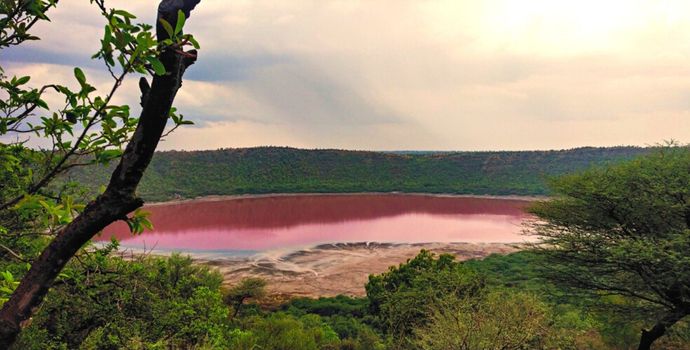
And no, even though it’s that saline, we wouldn’t recommend that you try floating here pretending you’re in the Dead Sea, as it is also dangerously alkaline, with a pH value of around 10.5 to 10.7. There’s a good reason that there are no fish in this lake and that animals don’t drink from it! In fact, a group of locals called the Lonar Lake Team says, “If we take a cup of water from this lake and add turmeric into it, then that lake water colour changes from yellow to red. This happens because of its alkaline nature.”
Some rather magnetic theories
And we aren’t extolling the scenic beauty and its diverse eco system that has resulted in it being declared a protected wildlife sanctuary. The soil in this region has some magnetic properties and sticks to magnets. The temple nearby, built near a depression (Ambar Lake) that was said to have been formed by a stray part of the original meteorite, has a nine-foot eighth century idol of reclining Hanuman which has been created from magnetic rock. Devotees toss coins onto it in the hope that they will stick, which they believe means that the god is granting them their wishes.
And now, scientists are also proposing a theory that the organisms that existed at the time of the impact may have consumed electromagnetic material from the meteorite and acquired magnetic properties thanks to the magnetite they ingested. Some believe these still live inside Lonar Lake! We may never know the real reason why the readings on a compass or electronic equipment seem distorted near the lake, but it’s fun to discuss the mysterious theories while you’re there.

A wealth of ancient temples
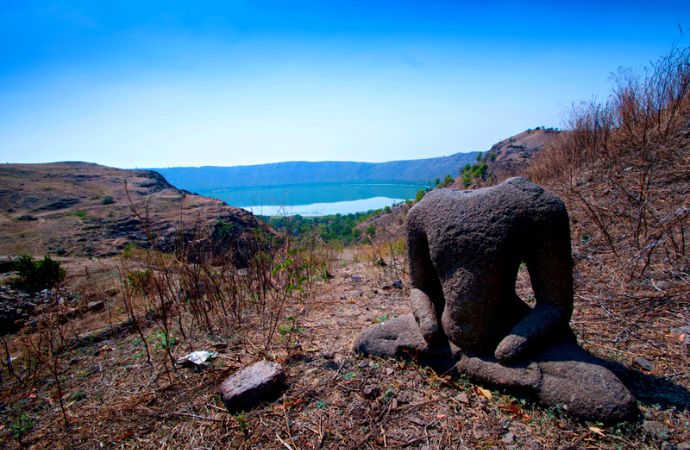
There are 12 ancient temples around the lake that date back a thousand years, some probably built by the Chalukya and Yadava kings in the tenth and eleventh century. While most of these Dravidian-style structures are dedicated to various avatars of Shiva, there is also a strong representation of the reverence of Vishnu. You’ll probably spot many ruined statues and carved pillars from the same time frame, but there’s also said to be a stone circle that perhaps dates back almost five thousand years ago. Even if you aren’t a pilgrim, these beautiful temples are worth a visit for their history, architecture, and picturesque location.
Good to know
Nearest railway station: Jalna (90 kms) | Nearest airport: Aurangabad (146 kms) | Hotels: Welcomhotel by ITC Hotels, Rama International, Aurangabad & Vivanta Aurangabad, Maharashtra (five star), and MTDC Resort Lonar (budget) | Other sights: The palace in the small town of Sindkhed nearby is worth visiting, as it’s the birthplace of Rajmata Jijabai (mother of Chhatrapati Shivaji Maharaj) in 1598 AD.
Read more.
Finding flamingos in Sambhar, India’s largest inland salt lake
Ellora Caves: A stroll back in time