
Carved out of rock in the mountains of Western India, Ellora Caves are a cultural and architectural masterpiece from medieval India.
Often neglected by the intrepid traveller in Maharashtra who prefers its much modern sister cities like Mumbai and Pune, Aurangabad has laid low through most of India’s medieval history. It was not until the 17th century that the town found its brief glory when Mughal emperor Aurangzeb (hence, the name) decided to crown it as the capital. Under his reign, between 1653 to 1707, a number of monuments were built that still fascinate many.
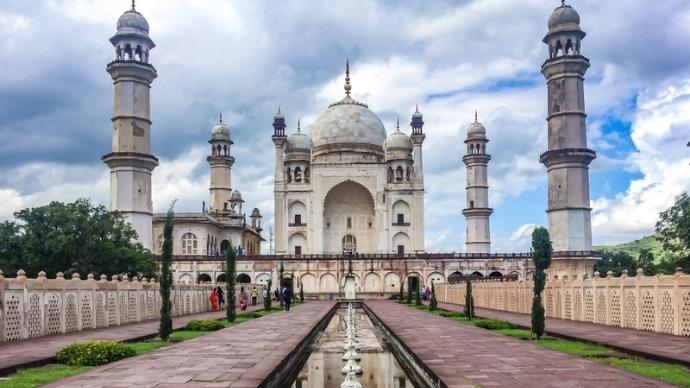
Ancient ruins, relics, and legends are very much a part of the soul of Aurangabad. Old-stone buildings, fortified gates, engraved walls, sculptures in ruin — the town has countless reminders of a glorious past gone by. Visit Bibi-qa-Maqbara (a lesser grand replica of the Taj Mahal), climb up the once-impregnable Daulatabad Fort through thousands of crumbly stairs, spike-studded doors, and murky tunnels, and later, enjoy a picnic at the popular Siddharth Garden and Zoo.
You can further spend your days shopping for Paithani and Himroo, the local hand-woven silk sarees and savouring local dishes like naan qalia, tahri, haleem, mawa jalebi, and more. However, the real reason for traipsing here is because Aurangabad is an ideal base for exploring the nearby Ajanta and Ellora Caves.
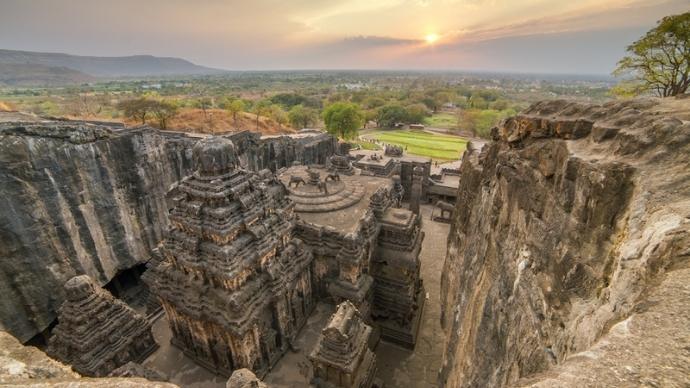
Ajanta has 29 Buddhist caves dating back to between the 2nd century BCE and 6th century CE, featuring the largest surviving collection of Indian wall paintings and sculptures from India’s history. While Ajanta Caves is always thriving with touristy crowds, arrive at Ellora for the real deal. Located merely 32 km from Aurangabad, these gorgeous series of mountain caves lie in the Marathawada region, along the gorge of horseshoe-shaped Waghur River. The UNESCO World Heritage Site is home to a collection of paintings, rock-cut sculptures, temple complexes.
They are among the largest rock-cut monastery-cave complexes in the world. Expect to witness 34 caves extending over 2 km and featuring a mixture of stunningly-carved Buddhist, Hindu, and Jain temple complexes. The incredible Kailasa Temple, which forms cave number 16 at Ellora, is undoubtedly the most famous attraction. The Hindu caves are the most dramatic in design, and the Buddhist caves contain the simplest ornamentation.
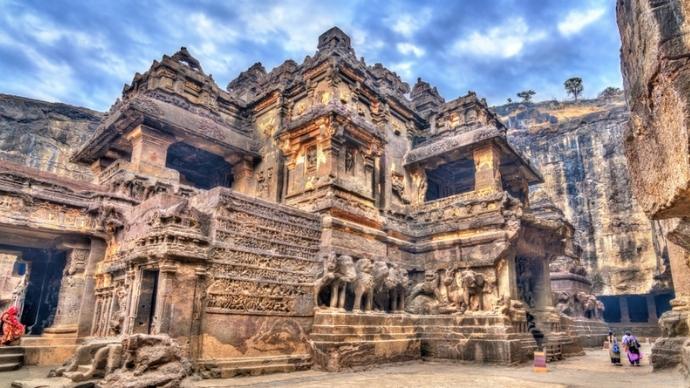
Ellora served as a group of monasteries (viharas) and temples (caityas); some of the caves include sleeping cells that were carved for itinerant monks. With their uninterrupted sequence of from 600 to 1,000 monuments, these caves may have been built during a number of dynasties including the Traikutakas, the Vakataka, Chalukya, Yadava, and more.
Still retaining the glory in their breathtaking sculptures and ruins, Ellora Caves are, however, all set to be future ready. As per the recent announcement by the Archaeological Survey of India (ASI), they are to become the first monument in India to get hydraulic lift! Superintendent archaeologist of Aurangabad circle Milan Kumar Chauley, said, “The ASI has been undertaking several projects to make Ellora Caves, which is spread across a stretch of 500 metres, more tourist-friendly. These projects are either in the process of being sanctioned or being executed.”
Read more.
Beyond Taj Mahal: 4 replicas of ‘the monument of love’ in India