
Iceland’s capital, Reykjavik is a lesson in how a city’s architectural style — that’s rooted in the past but embraces the future — reveals volumes about its inherent personality.

Reykjavik, the capital and largest city of Iceland, is known for its thriving nightlife and music festivals in Northern Europe. However, my eyes are drawn to something else entirely when I arrive in the capital of the land of fire and ice.
I am immediately struck by the whimsical metal-clad buildings — from Victorian to Art Deco — with gables and white window frames that line its streets. Most people talk about the lava fields, volcanoes, and glaciers in Reykjavik, the world’s northern-most capital of a sovereign state. Few mention its architectural delights.

As a result of the country being both volcanically and geologically active, there are few high-rise buildings, and the houses have wide spaces between them. Our cosy, industrial chic Airbnb with a kitchenette, is surrounded by these metal-clad homes, some a simple grey, others in shades of yellow, green and red.
Reykjavik’s eclectic houses counter natural disasters
As an architecture buff, I take a walk with Airbnb, which offers a range of guided walks to discover the city, tying up with local tour companies like Funky Iceland. Our guide Lalli — an Icelander — explains that the use of corrugated metal in Iceland became popular to counter natural disasters like volcanos and earthquakes, as well as scarcity of wood due to trees being chopped by the Vikings and fires that ravaged the cities.
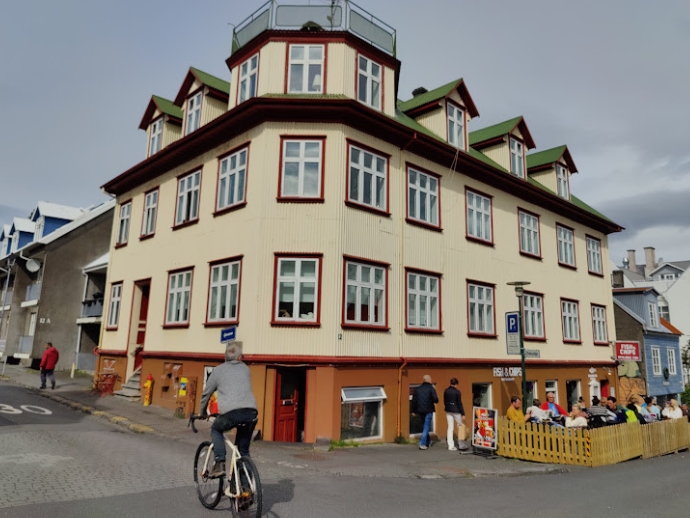
Unlike other countries, Iceland’s harsh terrain and lack of vegetation influenced its architecture. Until the late 19th Century, people in Iceland lived in homes that were damp and dark — where you had to burn peat to keep warm — built of turf, with walls of earth, wood, soil, and flat stone. “For the first thousand years, we lived in houses without a window. Through the rough climate and isolation, the turf houses kept the Vikings warm and the last turf houses were there in the capital even till the late 1800s,” says Lalli.
“Wealthy people like priests and merchants imported timber house kits from Scandinavian countries and even Russia that needed to just be assembled and hammered together on site. That is why we have such eclectic houses,” explains Lalli.
Corrugated iron makes an entrance in Reykjavik

When the Icelanders started trading with Britain in the 1800s, they discovered a new utilitarian building material that also provided good insulation from the wind and rains. Many ships would sail from Britain to buy sheep from Iceland and their cargo would include corrugated iron to sell in Reykjavik, as the material was well-suited to the volcanic island, with few construction materials. In the late 1800s, this became the most popular building material.
I understand that though in other countries corrugated sheets were mainly used for industrial purposes like build sheds, storages or barns, in Iceland the material proved so ideal for the local weather that it became universal to cover the timber houses with metal. The bonus was that these sheets were durable and termite proof.

Though initially the metal sheets were used on the roofs and to clad walls, they soon became popular to cover the entire timber to protect it from the elements. By dipping the iron in molten zinc, it was made weatherproof. While in other parts of the world the iron plates of such houses are applied horizontally, in Iceland they are vertical, making them suitable for fending off rain and snow and they also look more aesthetically pleasing.
The corrugated metal houses stand in bright, cheery colours to help counter the weather which is grey, especially in the long winters. Soon it also became an aesthetic concept and wealthy families built flamboyant houses in Swiss chalet-style, clad in corrugated metal.
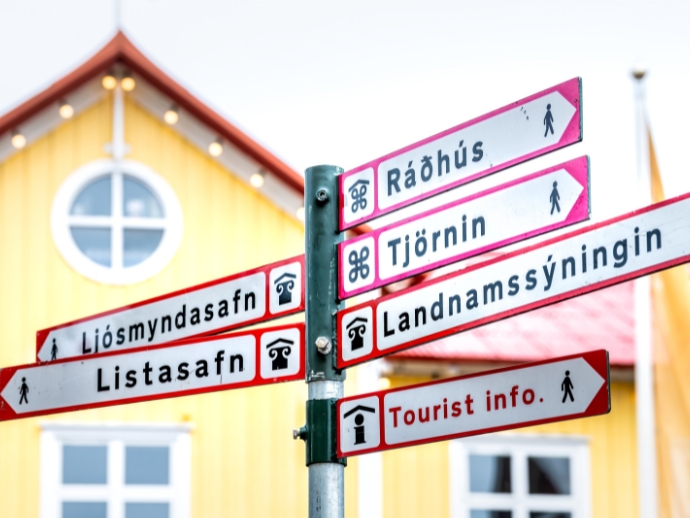
Image: Shutterstock/Andriy Blkhin.
We walk past the oldest house in Reykjavík clad with corrugated iron on the corner of Vesturgata and Ægisgata, built in 1881. Many streets are lined with the homes, shops, buildings and even churches built of corrugated iron in a variety of styles from Swiss chalet to even Russian-style domes. “Initially, prefabricated houses called catalogue houses were bought from countries like Norway, Russia and others, so there was no real Icelandic style of architecture,” Lalli explains.
Reykjavik’s Hallgrimskirkja Church: A labour of 41 years of love

Image: Shutterstock/veesaw.
The corrugated-iron house age was prevalent between 1880 and 1925. In 1915, there was a large fire in the city burning down many wooden homes and two people were killed. After this incident, a new building regulation laid down that only concrete or stone houses could be built henceforth in the city and that all old houses should have a corrugated coating. This gave Reykjavik the largest cluster of metal-clad buildings.
Not every part of Reykjavik has these corrugated metal structures. A young Icelandic architect, Guðjón Samuelsson was the one who changed Icelandic architecture forever and in particular that of Reykjavik, giving it an architectural style of its own. During the 1920s, Guðjón was asked to plan the main buildings that were constructed by the Icelandic state. Samuelsson designed many of Reykjavik’s iconic buildings in concrete and took 41 years to finish the impressive Hallgrimskirkja Church that rises in the centre of the city that was inspired by the basaltic columns that the country is famous for.
Reykjavik’s architecture is a seamless blend of creativity and utility

Image: Shutterstock/Nicram Sabod.
Not very far from the church is the futuristic award-winning Harpa Concert Hall and Conference Centre near the old fishing harbour, which opened in 2011, which was also inspired by iconic basalt columns and was designed by the Icelandic-Danish artist Ólafur Eliasson. It has 700 metal structures covering the glass facade of the building that reflect the light.
We walk past Iceland’s Parliament Building that was designed by the Danish architect Ferdinand Meldahl and built in 1880, from grey dolerite, a volcanic rock similar to volcanic basalt. An interesting counterpoint is provided by the city’s Lutheran wooden structure church that stands next to the Parliament Building, dating back to 1796.
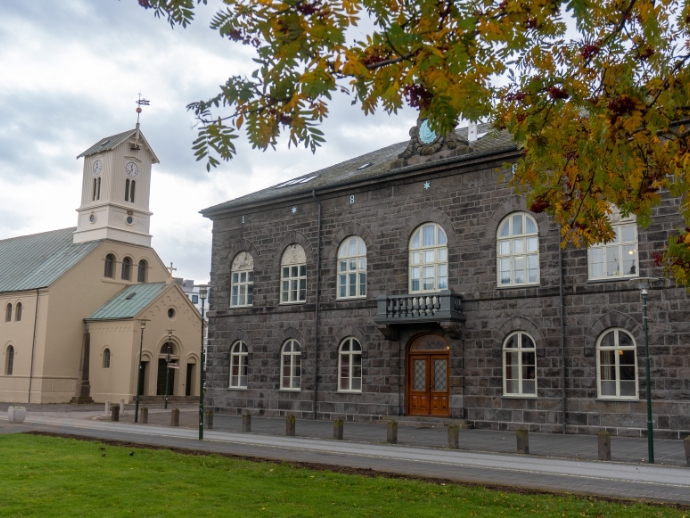
Image: Shutterstock/EWY Media.
Around 1990, there were ideas about either tearing down or moving these corrugated iron houses, but thankfully that didn’t happen as it is an important part of Iceland’s architectural history. Today homes that are a hundred years old or more, are automatically protected.
A city’s character is embedded in its architectural styles, and not many cities around the world can embrace change and different architectural styles, and still make it seem seamless, rooted in the past, but embracing the future, like Reykjavik has.
Read more.
Listen up, shutterbugs! This luxury resort in Iceland is looking for a ‘Midnight Sun Catcher’
From geothermal pools to swim-up bars — a look at Iceland’s brand new lagoon
Hvammsvík Hot Springs launch with gorgeous mountain views and rental homes