
The recent pop-up menu at Masque, Mumbai — in collaboration with Ahilya by the Sea — uncovered some unexpected finds from the depths of Goan waters that creatively and urgently address the ‘Food for Change’ annual campaign by Relais & Chateaux, a step towards slowing climate change.

The future of gastronomy is at a curious crossroad. A progressive number of restaurants around the world are constantly dabbling with local ingredients, seasonal produce, sustainable processes, and heritage preservations with contemporary concepts, all of which frequently reflect on their menus. But a crucial question stands: How many of us, as consumers, are actively thinking about the planet while a palatable plate of food on the table gazes back at us? Often, we eat the food, appreciate how creative and eco-conscious it is, talk about it with others, and the next day end up noshing on processed food and ingredients that leave a rather bigger carbon footprint on earth such as avocados, meats, and seafood.
Luckily, a rewarding perspective on ‘sustainability in food’ awaited a few of us recently at Masque and Ahilya by the Sea’s collaborative pop-up menu at Masque’s restaurant in Mahalaxmi, Mumbai. Amidst the chatter of the guests there, several glasses of cocktails on the tray floated around the room for us to indulge in.
I picked up a cocktail dubbed Martini by the Sea infused with one unexpected flavour that eventually rose through as the star ingredient of the night and pushed me to delve deeper into the power it may hold in the realm of sustainable gastronomy. That’s seaweed.
Adventures with seaweed
Seaweed was a delightful discovery that emerged from the food trail of Masque and Ahilya by the Sea on Goan lands. Both the establishments are members of Relais & Chateaux, a global chain of more than 580 hotels and restaurants run by independent owners and restaurateurs. Each of them works towards preserving and promoting local cuisines, heritage, and environment, which also finds a spotlight at the Food for Change campaign run annually by Relais & Chateaux and Slow Food, a worldwide network of communities to relaunch the conversation on local food traditions.
Yeshwant Holkar of Ahilya by the Sea reveals, “The whole concept of seaweed as an ingredient was picked up by Relais & Chateaux. They put out a global challenge to the members, saying we’re focussing on seaweed this year, how can you do it from where you are.” Words of encouragement or a guiding compass to the sustainability route, either ways, this challenge naturally became the protagonist of the pop-up menu by Masque and Ahilya by the Sea. But where does one find seaweed in India?
Back in India, on the coastal scapes of Goa, chef Varun Totlani of Masque, the first restaurant in India to become a part of Relais & Chateaux family, Holkar, and the team set out on an exploratory jaunt of gathering the most unexpected contenders for the menu, including seaweed.
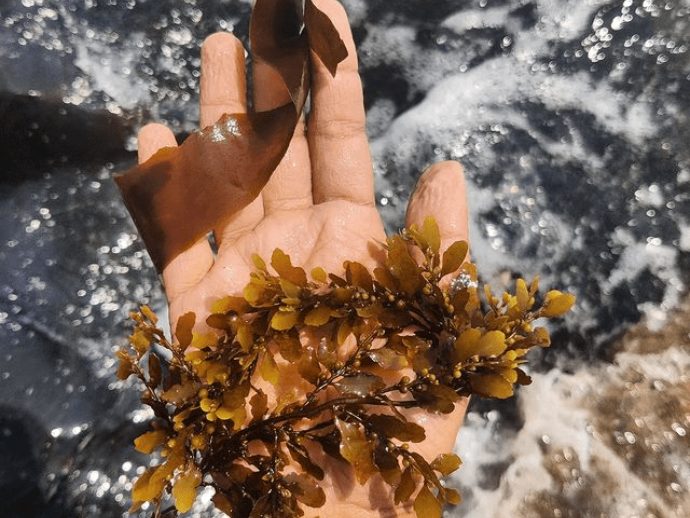
What Holkar calls an eye-opening discovery, Goa is home to around 100 to 150 varieties of seaweed, the aquatic algae plants that grow on the ocean beds, while the whole of India has close to 800 varieties. And most of them are edible! “This is where The Good Ocean, a local seaweed harvesting initiative by Gabriella D’cruz, came in,” states Holkar.
Chef Totlani, who came across The Good Ocean just this year adds that he wasn’t much aware of the existence of edible Indian seaweed until last year. “It has never been talked about in the Indian food sphere. So it was very interesting to work with this ingredient for the menu. There were two things I did for the pop-up. One was the seaweed broth to play with the umami flavour of it, which is also largely seen in Japanese cuisine. Another was the salad, where I wanted guests to taste seaweed in its true form and then be able to have it together with broth later.”

Thinking local with Relais & Chateaux
Talking about inventing the original version of the seaweed-infused cocktail we sampled at the pop-up, Holkar says, “At Ahilya by the Sea, too, the idea with seaweed was to use it beyond the common recipes of sushi or as toppings on salad. Thus, we used it in a cocktail and named it Martini by the Sea. Plus, it’s highly nutritious, readily available, low cost, and sustainable.”
Creating mass awareness and presenting seaweed as a thought-provoking ingredient was the intention and its pop-up version recreated by Ankush Gamre, the head mixologist at Masque, became a conversation starter as well, when the drink’s unique notes of umami, slightly sea salty, and a beachside freshness collided on our palates. At Ahilya, they have been experimenting with seaweed beyond cocktails, too. The team recently finished research and development behind the pantry, creating Seaweed Foogath, a recipe that is otherwise made with green beans and coconut.

As Holkar avers, “Our job at this stage is to push the envelope a little bit. Get people to experiment, think, and try. We’re slowly helping in a broader movement to get people to think about sustainability in food and seafood.” And that’s also the thinking that formed the eco-forward precis of the collaborative menu, a promising run towards Relais & Chateaux’s Food for Change campaign supporting regenerative farming to slow down the climate, change step by step.
Through Food for Change, Relais & Chateaux and Slow Food are diligently acting and pushing its members to be more mindful about the food system, which roughly contributes to about 30 per cent of greenhouse gas emissions.
The road to regenerative farming…
A certain word on Slow Food’s terminology — eco-gastronomy — describes our gradual and eventual food choices. It means recognising the strong links between plate and planet, and the fact that our food choices have a big impact on the health of the environment and the society we live in. The bridge that can potentially lead to fulfilling eco-gastronomy as a lifestyle more than a theoretic concept is regenerative farming or agriculture.
While there is no universally bound definition to it, but as Edward Mukiibi, President of Slow Food, describes it, it refers to farming in harmony with nature, protecting and restoring natural resources and a natural equilibrium to ecosystems, and a low, no, or net-zero impact on the environment.
While a uniform technique or method may not work equally for different continents and territories, the right approach, according to Mukiibi, is diverse. It comes from the experience of local producers and how citizens adopt eco-friendly choices. Collectively, the techniques can bring down greenhouse gas emissions, make soil more resilient against climate change by improving its ability to store carbon dioxide from the atmosphere.
At the end of the day, wherever and whoever is thinking of touching the boundaries of food sustainability in its most fulfilled ways, it might be pertinent to begin with being less exploitative and more open to exploring what our local lands have to offer, while wearing a conscious lens when looking at the natural resources around us.
Read more: