
On TravelDine’s recent exploration of Kashmir, we spent a wonderfully enriching morning soaking in nature’s bounty. This should count among your top things to do in and around Srinagar.
As serene as a shikara ride on Dal Lake is, if you’re looking for something a little more exciting while you’re in Srinagar, I recommend visiting the Dachigam National Park, only about 22 kms away.

I last walked this forest trail as a child back in 1988. Fortunately, while many things have changed in Kashmir, this forest is as beautiful and unspoilt as it was back then. They say there used to be 10 villages here, which were part of protected land right since 1910, initially under the care of the Maharaja of Jammu and Kashmir. By 1981, this was declared one of India’s first national parks to protect the flora and fauna within.

The critically endangered hangul, a red deer from the elk family which sports magnificent 16-point antlers, is mainly found in this forest and is the reason why wildlife enthusiasts from across the world want to visit. But, as there were fewer than 250 of them at last count in 2019, and they like to stay out of sight, catching a glimpse is quite rare.
The very shy deer are usually in the higher parts of the sanctuary (which goes all the way up to 14,000 feet above sea level!) There’s a better chance of spotting them in winter, when they descend to lower ground. Former PM, the late Indira Gandhi, an avid wildlife enthusiast for whom Dachigam was a favourite getaway, had done a lot for saving the hangul in the 1980s.

Apart from the Kashmir stag, there are 20 species of large mammals, nearly 100 species of trees, and more than 800 types of herbaceous plants found here. If you’re lucky, you could see two types of bears — the Himalayan black bear and Himalayan brown bear; a variety of felines — snow leopard, leopard cat, jungle cat; and other interesting species such as the Kashmir grey langur, long-tailed marmot, musk deer, jackal, hill fox, Himalayan weasel, yellow-throated marten, and otter.

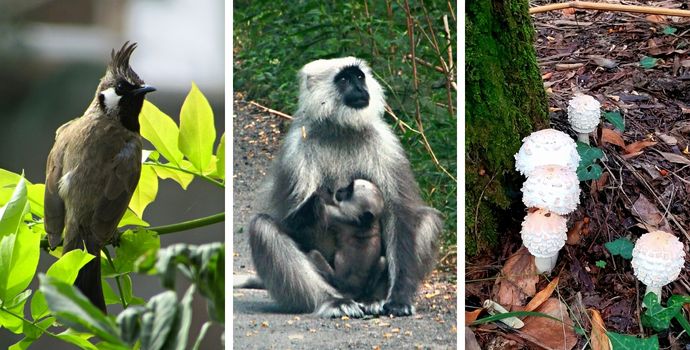
The bird life is lush with cinnamon sparrows, black bulbuls, Himalayan monals, golden orioles, minivets, pygmy owlets, redstarts, wagtails, Koklass pheasants, choughs, orange bullfinches, Kashmir flycatchers, Tytler’s leaf warblers, streaked laughingthrushes, Himalayan rubythroats, wallcreepers, Himalayan griffon vultures, and the red-billed blue magpie, and more, apart from the usual denizens of tree-rich areas — such as woodpeckers and babblers.

The eco-friendly cart takes you some of the way in, after which you can choose to walk or head back. Walking through the forest trails is not difficult and quite satisfying. The forest guard picks you fresh wild fruit like plums and berries along the way and you can stop to quench your thirst (for water as well as beauty!) at a mountain stream. Be prepared for cobwebs festooning your hair and pesky eye gnats hitching a ride on your lashes for some of the distance though.

What else you can explore in Dachigam
The hide: We chanced upon the hide built next to the salt lick (where salt is scattered so that animals can replenish their supply of minerals) which would be a great place to set up base for a day and watch wildlife without disturbing them.
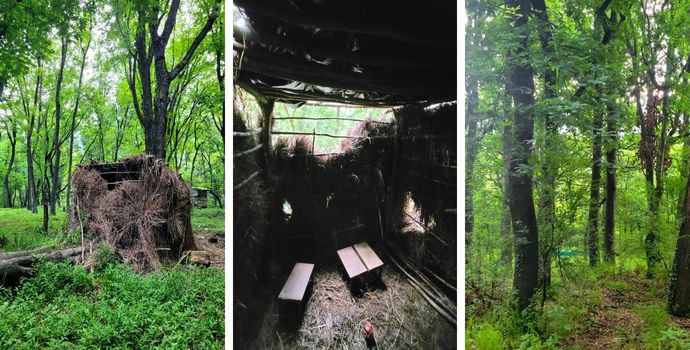
The ‘hut’: If you plan ahead, and have connections, you could get permission to visit the rather palatial colonial bungalow inside the core area, which has a beautiful watch tower near it.
The Laribal Trout Farm: This is much more accessible to any visitor. The rainbow trout here, as everywhere else in India, are not endemic to the land. American rainbow trout and English brown trout were first introduced into Indian waters by a retired officer from the British army between 1893 and 1897. The cold water from the Marsar lake high up flows down via the Dagwan river, which runs parallel to the park’s single narrow road. This merry stream is teeming with these trout. It’s interesting (and worth the time) to stop by and understand the process at the farm from one of the local trout experts at Laribal.

Good to know
Visit: The best time to come here is between April and October, although Dachigam National Park is open through the year. Please note that the park is closed every Tuesday.
Enter: As only a limited number of visitors are permitted daily, you will need to book your visit beforehand here. | Indians have to pay Rs 25 per head, foreign national Rs 50, and using a still camera costs at least Rs 100.
Stay: If you prefer to rough it a little bit, you can book the Panzgam Huts for about Rs 2,000 per night via the Forest Department website. | If you want sustainable luxury done right like we did, check in to the beautiful boutique property called Nadis, located opposite Harwan Garden, very close to the park entrance.
Bring: A light jacket, binoculars, a snack, your own bottle of water, and insect repellent.
Read more.
10 fabulous wildlife parks in India you probably don’t know about