
The old city of Ahmedabad has fascinating facets that await the avid explorer. Walk around these heritage precincts to unravel the rich Gujarati culture.
Walking through the ‘pols’, as the community clusters of the old city of Ahmedabad are known, is like stepping back in time. Standing at Mahurat Pol, which is the first pol of the city, I spot the building of the old stock exchange located opposite. The colonial structure is counted among the first three stock exchanges of the country.

The Rani no Hazira, which translates to tomb of the queen and Badshah no Hazira or tomb of the king are within walking distance of the pol. The tomb of Ahmad Shah, the founder of Ahmedabad, is also located here. The area is collectively known as Manek Chowk and is clearly a bustling part of the old city courtesy and the second largest jewellery market in terms of turnover.
The chowk that never sleeps…
Ahmedabad is famous for its street food and Manek Chowk transforms into a ‘khau galli’ with an appetising array of options at night. It’s almost as if the chowk never sleeps and dons various avatars in a day.
Early morning, the area awakens to bhajans, followed by people feeding cows. Market activities keep the chowk busy during the day while in the evenings, the food stalls whet the appetite. There is never a dull moment at Manek, which also has the Jama Masjid, which was built in 1423 by Ahmad Shah. The masjid is also called Jami or Jumma Masjid. The impressive mosque has an expansive central courtyard with the wazu.

As I exit the masjid, a Jain monk walking barefoot and clothed in white walks past. I follow him and find myself at the Jain Mandir dedicated to the third Tirthankara, Sambhavanatha, with the emblem of a horse. I knew the temple was dedicated to Sambhavanatha because each Tirthankara has his own distinguishing emblem. This underground temple practices sustainability as rain-water harvesting is used to wash the idol.
When pols are symbols of unity in diversity…
While the word pol may be derived from the Sanskrit word ‘pratoli’, in ethos it is an example of unity of diversity. Every community had their own pol in the city. This was done as each community has its own festivals, customs and culture, that could be followed in their respective pol while ensuring that the peace of the other communities was not disturbed. Even though each community lives in its pol, since these clusters or neighbourhoods are close to each another, there is no alienation. Even today, the residents of these different pols live like one big joint family. At one time, Ahmedabad had almost as many as 600 pols.

I continue to walk, soaking in the vibe of some of these pols that have narrow lanes, old wells, temples and the omnipresent otla or meeting place. There are also notice boards in Gujarati informing members of events happening in the neighbourhood. An interesting feature of the pols is their chabutaras or bird feeding towers. While the old city where the pols are located is an architectural marvel, a very noticeable factor is the absence of trees or foliage.
In such a situation, chabutaras serve as a feeding haven for birds. I look up at a 110-year-old chabutara that has been coated in green, perhaps to give the illusion of it being a lush tree. These feeding stations are very thoughtfully designed and made of either stone or wood.
They consist of a granary that is located underneath to store the grain. A ladder is used to climb up for placing the grain, as the bird feeding enclosure is constructed at a height. This is done to keep predators like dogs and cats at bay. Some of these structures are intricately decorated and have interlocking styles that are rather complex. The chabutara at Doshiwada ni Pol is even decorated with stained glass, a hat-tip to colonial architecture.
When pols are cultural melting pots…
The houses of this pol resemble havelis and have grand façades. They mostly belong to goldsmiths who live and work here. There is a Jain library and a marble derasar that was built in 1856 AD. The statues inside this Jain temple have been made with red and black marble. I pass a number of shops selling jewellery as I walk to the next cluster.
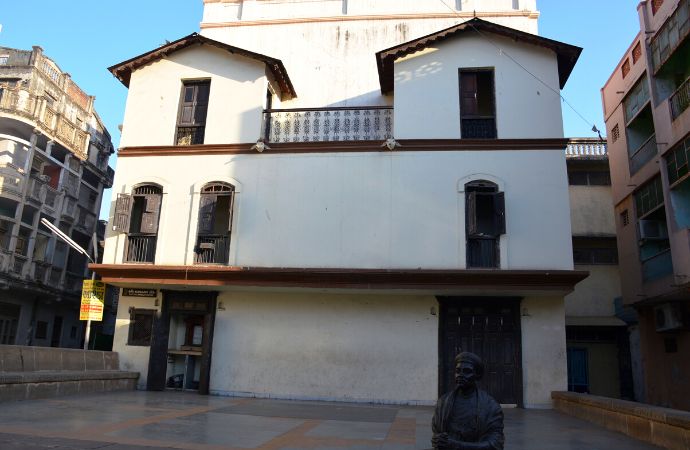
At Lambeshwar ni Pol, I learn about the life and times of Kavi Dalpatram, a very famous poet of Gujarati literature of the 19th century. Visitors are greeted by his statue and the façade of his home which is now his memorial. The old homes of most of the pols have been built with layers of wood and brick. It is this wood used in their construction that helped to absorb the shock of earthquakes and keep these architectural sentinals intact.
The birds seem to be having a gala time. I hear a rather loud squawking and look up to see a flock of parrots fly away. Their home is a bird hole that they have created in the exterior walls of an old house. Located high up on the walls of houses, these small niches shelter birds and give the residents an opportunity to wake up to bird calls rather than the cacophony of horns so typical of our urban concrete jungles.
At the Haja Patel ni Pol, there is a stone well that in its heyday provided salty water. Today the water may have dried up, but the stone well still stands tall in the pol. There is also the 407-year-old Kala Ramji Mandir. The idol of Ram is seated and flanked by Laxman and Sita. All three idols are carved from kasauti, which is a jet-black stone that is also used to test the purity of gold.
An elderly citizen of the pol told me that these idols were buried underground and found by a gentleman named Hariprasad, who built the temple. The temple courtyard has intricately carved teakwood brackets while the priest explained that the clothes of the idols are changed daily. In summers, they are clothed in white cotton while winters have them dressed in woollens.
Each walk through the pols of Ahmedabad gives you fresh perspectives and new discoveries, so you can never tire of exploring them.
5 Interesting facts about Ahmedabad pols
- Mahurat Pol is the first pol of Ahmedabad.
- Manek Chowk, which turns into khau galli at night, also houses the Jama Masjid, built in 1423 by Ahmad Shah.
- The pols are peppered with intricately decorated chabutaras or bird feeding stations, made of either stone or wood.
- The old homes of most pols have been built with layers of wood and brick to help absorb the shock of earthquakes.
- At the 407-year-old Kala Ramji Mandir in Haji Patel ni Pol, the clothes of the idols of Ram, Laxman, and Sita, are changed daily — white cotton in summer and woollens in winter.
Read more.
Atal Bridge: Ahmedabad’s hottest new attraction at Sabarmati riverfront