
This Durga puja don’t restrict yourself to just khichuri for bhog. From pickles to pitha, satiate your soul with traditional Bengali puja delights!

Durga puja is intrinsically entwined with feasting. That is at the heart of the autumnal festivities honouring the goddess. The highlight of this culinary extravaganza that unfolds during these four days is the Bhog—food ritually offered to the goddess. But talk about bhog, and the conversation invariably veers towards khichuri—the runny rice and lentil porridge that is a staple at community lunches at puja mandaps across the city.
But khichuri is only one of the many dishes that are offered to Durga. Durga puja’s bhog entails a variegated culinary tapestry—vibrant and diverse—that not only reflects scriptural mandates but also culinary ethos of the region, seasonal and regional affiliations, unique family traditions, and even caste diktats.
In the mood for some aristocratic bhog?
This diversity of bhog is best seen at the household Durga pujas across Kolkata and Bengal, particularly in the homes of Bengal’s erstwhile aristocracy—the Bonedi Baris. Here, depending on tradition and school of worship, bhog could range from sprawling spreads featuring everything from unctuous ghee bhaat or rice cooked in ghee with fragrant whole spices and saffron-hued pulao chockful with nuts and raisins, different kinds of vegetables, stewed, curried and deep fried, and chutney, to an austere meal of luchi and three kinds of vegetables fried in ghee, without salt.
Bhog can range from sprawling spreads to an austere meal, depending on tradition and school of worship.
In fact, not every home offers khichuri or pulaos as bhog. According to age old caste-based diktats, only Brahmins are allowed to offer annabhog or cooked rice to the goddess and hence in non-Brahmin households it is not a part of the bhog offerings. Instead, a rainbow of sweet and savoury dishes made with luxurious ingredients like maida, ghee and sugar take centre stage. At North Kolkata’s eminent Laha bari for instance, a wide assortment of nadu (spherical confections), made with everything from sesame and coconut to different kinds of lentils and semolina, intricate pastries fried in ghee and soaked in sugar syrup, and sweetmeats like caramel-hued ledikeni and plump pantuas are made by professional confectioners on the home’s premises—a system called bhiyen.
Eat your heart out this Ashtami!
Ashtami at the famous Shovabazaar Rajbari sees one maund of uncooked rice on gigantic salvers—the size of tonga wheels—offered to the goddess. “Every evening michhrir jal (sugar-candy water) and butter are a must,” says Tirthankar Deb, a scion of the family. Professional confectioners are summoned to the house to prepare a range of sweet and savoury dainties like khaja, gaja, balushahi, along with piping hot kochuri, shingara stuffed with lentils, crusty nimki (savoury pastry) shaped like an open lotus and massive radhaballavi, fried bread stuffed with spiced lentils.
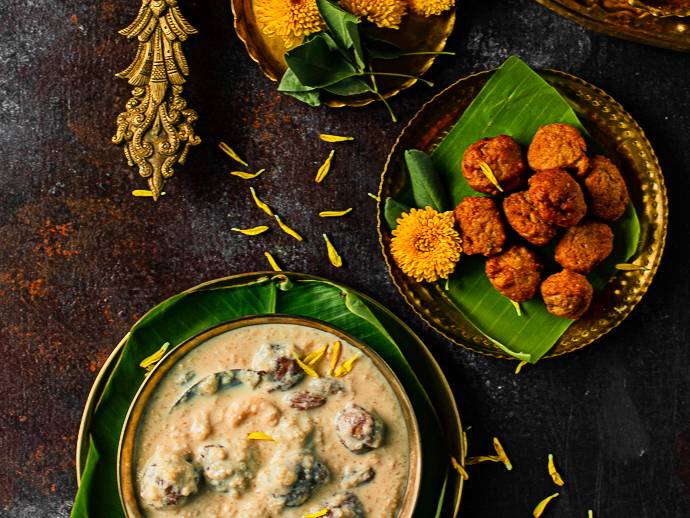
Additionally, there are heirloom family recipes passed down through generations like the motichoor that, unlike the common saffron-hued one, is pristine white in colour—just like pearls—and the unique pokanno. “The pokanno is made with ghee-fried strands of besan batter combined with khoya, dried fruits and nuts and rolled into balls,” says food blogger Maumita Paul Ghosh, who went on an exciting expedition collecting heirloom bhog recipes from some of the city’s Bonedi families a few years ago, and recreated them for her blog.
Heirloom family bhog recipes are passed down through generations to retain tradition.
Again, at Pathuriaghata’s Khelat Ghosh’s household puja, a delicate kheer laced with sandalwood called Chandana Kheer, and saffron-tinged rabdi are mandatory offerings to the goddess. Ghosh talks about other intricate dessert recipes she has encountered on her explorations. There’s the kolar borar payesh—deep-fried balls of mashed bananas combined with a fudgy concoction of coconut and jaggery and added to a luscious payesh made with fragrant gobindobhog rice and milk—offered at Raja Rambrahma Roy Chowdhury’s 337-year-old puja in Shibpur. Or, the rajeshwari—fried dough stuffed with coconut, jaggery and khoya and soaked in jaggery syrup—at Sheoraphuli Rajbari. “What’s striking is that most of these recipes have remained unchanged for generations,” says Ghosh.
A bitter-sweet homecoming for Durga
However, while every household has its own culinary traditions and rituals, many rooted in the family’s own history, the one common sentiment that underpins Durga puja celebration everywhere is that of parental affection. Durga is the daughter of the household who visits her natal home once a year from distant Kailash and she must be fed all our favourite things, and by extension, hers. A unique tradition at the Mitra household of Darjipara is to offer the goddess a range of pickles—kul (plum), tentul (tamarind), aam (fresh mango) and aamshi (dried mango) —different kinds of bori or sun-dried lentil pellets made at home and reserved for beloved Durga’s homecoming. In other homes, she is offered a variety of pitha or sweet rice cakes painstakingly prepared by the women of the household.

Non vegetarians? The bhog has you covered!
However, the bhog need not be a completely vegetarian affair. Shakta and Tantric traditions of worship that have strong roots in Bengal mandate the offering of matsya (fish) and mamsa (meat) to the goddess. Plus, in riverine Bengal, fish is not only the cherished staple, it is also gravid with symbolism and sentiments. All these mingle and culminate in the matsya bhog offered to the goddess.
The kinds of fish offered to Durga vary from scale-less, dark-skinned bottom feeders like shol (snakehead murrel), lyata, boal (wallagu aatu), and chang (spotted snakehead) to the massive, silvery beauties like bhetki, ilish, chital andrui—cooked into cumin-scented curries, stewed in mustard gravy or simply deep fried. In some homes, the goddess is ritually offered charred fish —typically sholorlyata—as part of the bhog. Such traditions and rituals are likely to be vestiges of the primitive, tribular roots of the adoration of the goddess.
Though bhog can, and does, feature non vegetarian fare, the use of onions and garlic is strictly prohibited.
But even if fish, and meat, are part of Durga’s bhog, alliums like onions and garlic are strictly prohibited in these preparations—a practice more aligned with Vaishnav traditions. “For instance, at the household puja of the Chatterjees of Chorbagan, Durga is offered dishes like bhetkir niramish ghonto —a melange of bhetki (sea bass) and a medley of seasonal vegetables flavoured with cumin, ginger, ghee and a hint of garam masala and the chingri niramish malaikari, cooked with fragrant spices and generous lashings of milk, coconut milk and yoghurt,” says Ghosh. “Niramish (vegetarian) implies no onions or garlic is used in these dishes,” she adds.
Food historian and consultant Pritha Sen mentions the jhol’er bannyon—a light dish made with a cornucopia of indigenous vegetables like banana stem, pumpkin, unripe bananas, ash gourd, fish head and some shrimp—that she sampled at a household Puja in South Kolkata.
Farewell Durga, with a heavy heart (and cold food)
On Dashami, the final day of the pujas, in many households (particularly ones with roots in East Bengal) Durga is typically offered shital bhogor (cold food), prepared the night before. The spread typically comprises panta bhaat or cooked rice fermented in water overnight, khesari dal or grass peas, taro stolon or cooked with hilsa head or freshly grated coconut and Bengal gram, and a mouth-puckeringly tart chutney made of elephant apples. The simple rustic meal is evocative of agrarian roots of the land on the one hand, on the other, it is rooted in a rather familial sentiment. It is said that Durga only gets to eat cold food as overcome by the sadness of bidding farewell to the daughter of the house, no one is in the mood to cook on Dashami.
So go and feast on the bhog of your choice this Durga puja!