
India is on the threshold of its next wave of caffeine boom, and that’s specialty coffee. A chat with expert David Hogg, Chief Agriculture Advisor, Naandi Foundation, reveals layers of coffee beyond its reputation of a grab and go drink, and into the deep sea of science and environment.

Year on year, the demand and supply for Indian coffee in the global market has been on a leaping ascent. Counted among the top 10 largest coffee exporters, more than 70 per cent of the country’s coffee is relished across different parts of the world than by domestic coffee consumers. While that iterates the unshakable presence of our regional coffee on the world map, it also underlines the existing vacuum of a well-grounded coffee culture in India.
However, an educating chat recently with David Hogg, Chief Agriculture Advisor, Naandi Foundation, the biodynamics expert from the house of ARAKU COFFEE — a brand that has over the years unravelled the intricate but equally intriguing dynamics of high-quality coffee out in the open to the local consumers — finally answered a burning question of mine: What’s really up in the realm of Indian coffee today?

The single-origin 100 per cent organic coffee brand by Naandi Foundation, ARAKU COFFEE’s story began as early as 2001. Through the years, its mettle has been shaped and reshaped with elements of science, regenerative farming, farmers, and the people working behind the scenes. But importantly, it is ARAKU COFFEE’s disciplined drive to unearth the finest gem-worthy coffee beans from its namesake terroir of Araku Valley in Andhra Pradesh, where each fruit coexists with a familiar semblance but is as much unique in character and flavours.
When you zoom in, ARAKU COFFEE’s dexterity in coffee is a lot more complex, elaborate, and informed. Of the many lots and heaps of roasts that come from its trove, the microlots are seemingly their favourite subject to indulge in. Hogg says, “We had issued lot 58 a few years ago and people still talk about it.” Now, an all-new batch of limited edition microlots is the latest at ARAKU COFFEE, sourced from farms with similar elevations that bind the coffee together with a nuanced flavour profile. The lots are in a specialty coffee score of 84+, endorsed so by an international expert jury.
But first, what’s specialty coffee?
To earn its top performance badge, just like anything else, coffee too goes through a careful evaluation before being declared of its quality. A non-profit, membership-led Specialty Coffee Association or SCA since 1980s has been scoring coffees around the globe on a 100-point scale. The brew is assessed for its aroma, acidity, sweetness, body, aftertaste, and other factors, after which its ‘specialty coffee’ status is only ascertained if it bags a number between 80-85 and above.
The macro story of microlots

Hogg believes microlots as a term has often been abused and overused. “In ARAKU COFFEE’s case, microlots mean small lots that can be anywhere around 200-300kgs. Within that, there’s another term ‘nanolot’, which is very often intermixed with the other. It is usually one gem of a coffee which is found at a particular farm and might only make for one bag or about 20 kilos in total.”
Where do these microlots come from, though? Are there farms and terroirs that are especially prepared to harvest it or is the process similar to that of growing the regular lots? ARAKU COFFEE comes from the 3,000 sq km area of land in the South Indian valley in a longstanding collaboration with the local community farmers who have been oriented to focus on higher quality specialty coffee that often depends on the soil, climate, patterns of rains, first blossom, and so on. Naturally, these special coffee lots need a perceptive consumer base, too. “So we assiduously began to categorise and filter the ‘gems’ of ARAKU as we call it and were careful to not mix it with the general category SKUs,” explains Hogg.
“These lots could vary based on micro-climate, early harvest, signature, or raw reserve. These categorisations enabled us to then concentrate on getting higher and higher quality coffee from individual and group of farmers. Thus, giving ARAKU COFFEE its specialty microlots.”
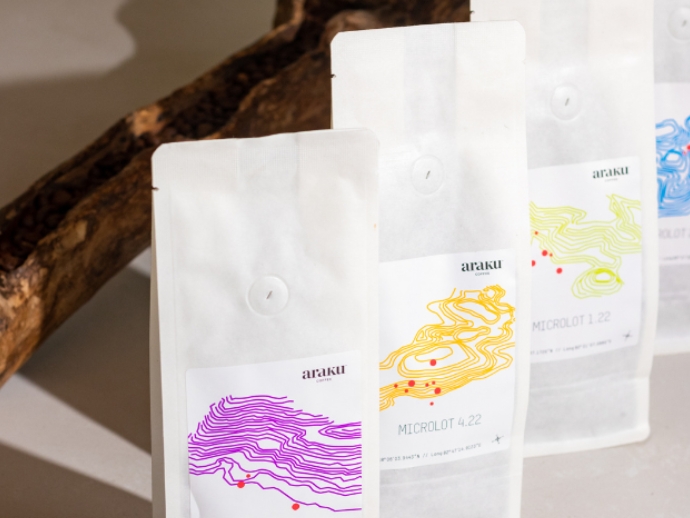
Microlots emerge winners post a rigorous, dedicated process of finding the ‘one’. “When we have the harvest coming in, we create lots, which are then tagged and stored in the storage area. Sometimes farmers pick coffee beans 6 to 7 times in one season. We try to consolidate those into one lot,” reveals Hogg. By the end of the season, these lots are identified for commonalities such as soil and climate, leading to the creation of larger lots, which are then cupped for tasting and scoring on the SCA scale.
Hogg adds, “Cuppers cup the lots and single out which taste profile matches with which lot. We don’t want to put low altitude coffee with higher altitude one because there could be jarring elements on the palate when it comes to specialty coffee. In order to align this, we look at the elevation of the farm, rock structure etc. The cup tasters who can point out these different nuances determine what could be a micro lot instead of a larger lot. That’s how we discover our gems in doing the tasting process.”
As it turns out, the science of coffee gradually spills into becoming a personal process with an objective evaluation where a discerning sensibility proves crucial. Hogg agrees and says, “That’s the beauty of going beyond commodity and into products.”
What’s in it for the farmers?
Over 90 per cent of farmers in India are small farmers with less than two hectares of their own land. Hoggs divulges, “The tragedy was that the small farmers were never encouraged to seek quality because there were commission agents mediating. Whether they picked green coffee, ripe coffee, black coffee, or the dried beans fallen on the ground — it was not their interest because there wasn’t any incentive.” With the establishment of ARAKU COFFEE, they got the farmers together and created a coffee cooperative along with conducting regular coffee training. It was also an initiative, first-of-its-kind, as Araku Valley was still a very unconventional region to helm a strong coffee movement from, unlike Coorg that had the tradition of coffee farming since years.
“The brand had to embark on a long education program, organising meetings, creating videos to describe what good coffee is, doing cup tastings with different types of coffee,” says Hogg. This led the team to a surprising but assuring discovery. The farmers shone through with a highly refined palate where they were able to differentiate one coffee from the other. “Over these 20 years, we have built a community of coffee growers who know what they are doing.”
Coffee, chemistry, and biology
When the two decades-old coffee brand arrived in the Araku valley, the land they had to initially work on was degraded but not abused with chemicals. All that was needed was a meticulous approach in building back the land and soil’s microbiology. Hogg informs, “One of the important things about coffee’s taste is the presence of a certain yeast called saccharomyces cerevisiae that lives around and on the coffee, and gets infused in it.”
During their research on ripe coffees a few years ago, ARAKU COFFEE’s in-house microbiologist discovered yeasts she’d never seen before. After getting it DNA tested and checked in the labs, Hogg reveals, “We realised the reason these yeasts still exist is because at no point in our process we used chemical sprays. We then took it one step further and isolated the yeast in her lab and took the mother cultures to ARAKU COFFEE’s farms, fed it glucose, developed them and put them back in the coffee cultures to ferment.” Interestingly, the story of coffee between its journey from seed to cup is curiously layered, with substantial, scientific and rather exciting processes that emerge in the invisible world of microbiology.
Read more.
Masque: Unexpected local ingredients are changing the future of sustainable gastronomy
India’s beer renaissance: New BrewDog pubs set to launch in multiple cities