
Moghul Sweets in Singapore has made a place for itself by striving to adhere to the basics of every food venture: Affordability and quality. And this Diwali, all roads lead to this store for their coveted confections
The story goes that a woman who stood in a long queue outside Moghul Sweets in Singapore sent away a social distancing ambassador when the pandemic was in full swing. “If we observe social distancing here, the queue will reach Mustafa Centre a few lanes down,” she said.
She was right.
Sweetness and light and everything’s all right!
Moghul Sweets is a shop where people queue for an hour or two on festive days to buy the ever-popular North Indian mithai. Set up in 1996, Moghul Sweets has swum against the tide by not only standing steadfast in the face of a pandemic, but by also maintaining its standards. No wonder then that the establishment is one of the most sought-after sweet sellers in Singapore.
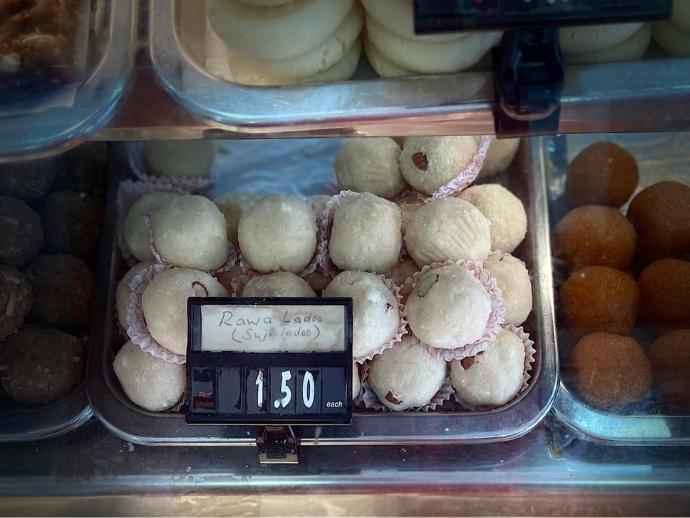
A modest little shop on Serangoon Road at Little India Arcade, Moghul Sweets prides itself on being the first shop to sell North Indian sweets in this city-state. Established by the late Niranjan Singh Jesal, Moghul Sweets is the smaller arm of Moghul Mahal Restaurant, established in 1983.
I walk in to see 76-year-old Din Najmudin who has worked at Moghul Sweets for nearly 18 years.
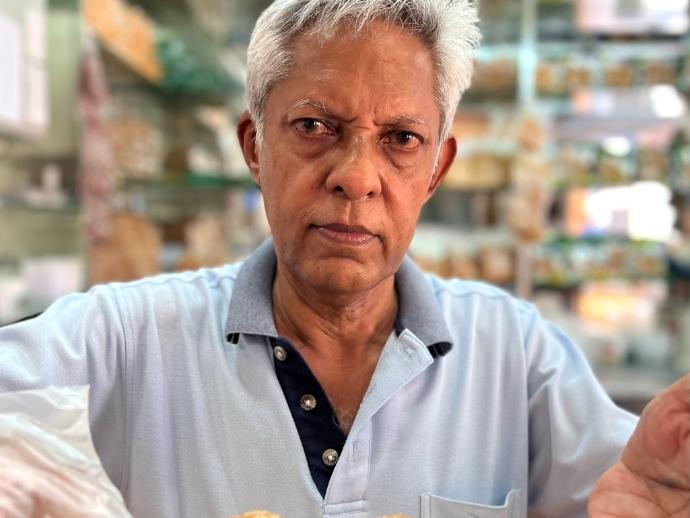
He tells me that the shop serves sweets, snacks — such as dhoklas, murukku, namak para and samosas — and fresh paneer. “Motichoor laddoos are our signature product,” says Najmudin.
When laddoos are your go-to
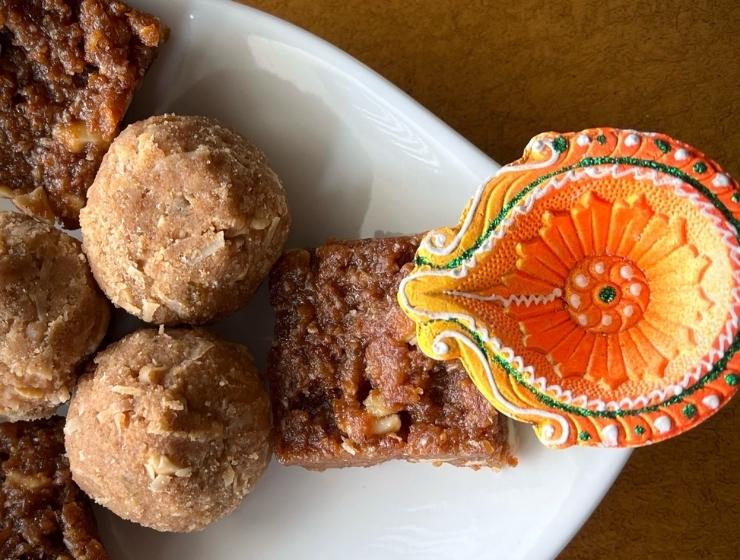
The glistening balls of laddoos are exhibited along with a grand variety of mithai such as Pinni, Kesari Pedha, Karachi Halwa, Mathura Pedha, Pink Tikkee, Suji Halwa, Dil Kush, and Chocolate Burfi to name a few.
The Motichoor of Moghul Sweets is light and fragrant. It’s different from the ones I have eaten so far. The boondis are small and soft, and mildly sweet.

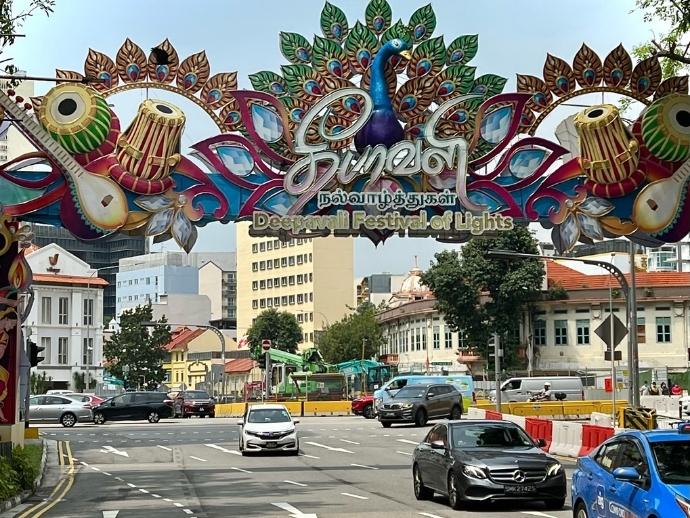
Little India is bang in the middle of all the Deepavali chaos that Singapore sees every year. The roads are decked up and all sorts of baubles and bangles wink in the sun. It’s a big festival for local Indians and for the massive migrant Indian community that spends hours looking for the right sweets and the right gift boxes.
Moghul Mahal has a website (moghulmahal.sg) where people can pre-order mithai in bulk. The establishment gets hundreds of orders apart from the sales that this little shop sees. Najmudin tells me that Moghul Sweets sells mithais that are not as sugary as the ones sold in India.
I agree, and perhaps that’s the reason for its popularity.
He adds that there is no compromise whatsoever on the ingredients that go into making the mithais. Much of the ingredients are sourced from Malaysia or India, and the sweet makers know what it takes to satisfy the Indian palate. “It’s important to maintain consistency but all human beings are prone to error; we try our best to minimize the ups and downs,” he says.
All roads lead to Moghul Sweets…
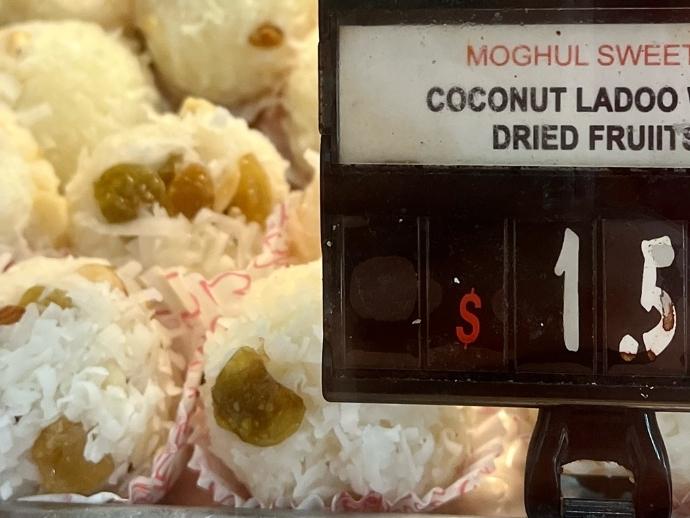
Reasonably priced at $1 to $3 per piece, the mithai comes from the kitchen at Moghul Mahal daily. I notice that some of the trays look half-empty even before the sun climbs overhead.
“There was a maid who came here looking for sweets, and she told me they are for her employer who was returning from India,” says Najmudin. He laughs and turns to pick some coconut laddoos for a customer. “Even those from India prefer Indian sweets that are sold here in our shop,” he adds.
A few tourists troop in. They stand and stare at the colourful cubes that smile at them through the glass windows.
For a majority of non-Indians, mithai means colour. It means culture. It means the entire history of a country that has a lot of stories to tell.
I wait to see what a young non-Indian couple would choose. The woman points at a humble Besan laddoo and moves on to a rich semolina sweet, and tries to pronounce the name of a luminous orange mithai that grabs her attention.
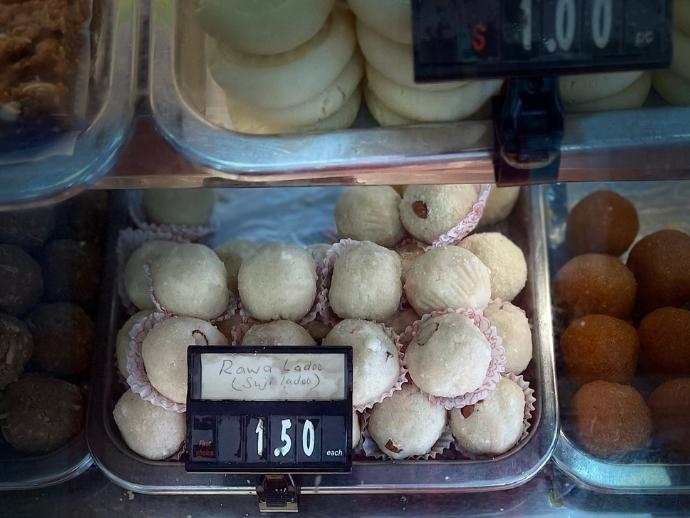
“That’s Kesari Halwa,” says Najmudin.
He tells me that the only challenge in running a shop such as this is the need for tact in managing impatient customers who may have had a bad day.
Getting good sales staff is an issue too. “Gone are the days when you could hire sincere people,” rues Najmudin.
He moves back and forth as an unsure client points from one sweet to the other. The lady finally chooses a juicy Chum Chum over the milky Paal Gova.
“There are some who come back years later and look for me. They remember me because of the sweets,” he says.
He offers me a golden-brown samosa with tamarind sauce, but I am in no mood to eat. “Try our Kaju Katlis or Gulab Jamuns, or Ras Malai,” he coaxes.
What does he like to eat, I ask.
“Our Kalakand goes well with my evening tea,” says Najmudin as he packs a few Gond laddoos for me.