
Sariska is a celebration of nature and all things wild. Beware, you are in for a series of surprises in the wilderness and beyond!
The nippy air froze the bare parts of my face, my throat felt dry, and my heart raced as our open jeep roared and zoomed through the bucolic route. The dawn began to break slowly, letting the golden rays from the rising sun in, which pierced through the dense, milky fog, and brought along some much-needed warmth.
In my head, I was comparing our early-morning safari in the thickets of Sariska Tiger Reserve in Rajasthan’s Alwar district, to playing a game of Scotland Yard. Just how in the game, a group of detectives pick hints to chase down a certain Mr. X, we, a curious bunch of six, were following the pug marks and carefully listening to the alarm calls to chase down the ferocious, ever-so-chanting tiger.

My chain of thoughts drawing this random analogy was suddenly broken when Kushagra, the resident naturalist at Utsav Camp Sariska, asked the driver to stop. He pointed out at a beautiful sambar deer in the wild bushes, and then, to a grey langur on top of a tree right above it. “Did you know monkeys or langurs usually befriend deer, and they warn each other with alarm calls whenever either of them sight a danger? The primates watch the jungle from the tree-top (they even throw down fruits for their friends to eat!), and the deer have the duty to keep an eye on the land. They share a unique bond,” he said.
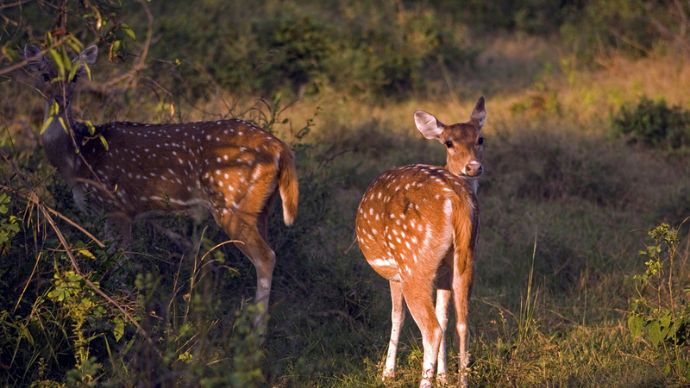
That’s when it hit me: There’s so much more to a jungle safari than just mindlessly chasing the big cats! Of course, sighting a tiger or an elusive leopard in the wild is thrilling, but so is exploring the deeper ends of a deciduous forest, observing a friendship between jungle residents, spotting a strange fruit that grows nowhere else or a rare migratory bird that flew thousands of miles looking for a winter shelter.
A wild, wild land
Amid arid forests, rocky hills, and stretches of grassland biome in Alwar, Sariska exists as a safe home to an incredibly diverse range of flora and fauna. Set against the backdrop of the majestic Aravallis, Sariska Tiger Reserve sprawls across an area of 800 sq km. A total of five tigers were reintroduced in the region in 2009, since when the number has grown to 27, helping Sariska slowly climb its way up among the most amazing wildlife circuits in northern India.

We were meandering through the pristine Bagani region of Tehla gate in the southern part of the reserve. What fascinated me the most about Sariska was that it has everything from grasslands, dry forests, to sheer cliffs and giant boulders. There’s even a part where you would see hundreds of towering palms swaying along the wind! Other than the tigers, the diverse landscape is home to 80 leopards, wild boars, grey langurs, mongooses, sambar deer, blue bulls, antelopes, and over 220 species of indigenous and migratory birds.
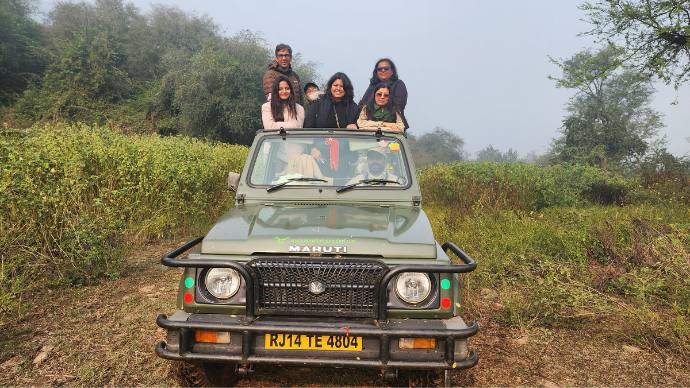
When you shift your focus from the big cats, and open yourself up to more experiences on offer, the jungle truly takes you in, and blesses you with rare encounters that may be otherwise restricted to the absent-minded. During our two early-morning safaris, I locked gaze with a huge sambar, was smitten over by a family of black-naped hares, got our jeep chased by a wild boar, saw jackals sunbathing on top of a boulder, spotted a bunch of long-legged Sarus cranes perched at a pond’s edge, and saw a pair of pallid scops owls snuggling in a hollow dhok tree.

From a guided boulder hike to locate a leopard and her cubs, to observing birds at low-lying scrub forests and water bodies, to tracing the pug marks of a hyena after dusk and tracking a bushy-tailed fox during an adventurous night safari, I witnessed the wild in action like never before.
Beyond safaris and sightings
Other than the wild encounters, our days were spent knowing what’s beyond the jungles of Sariska. Luv Shekhawat, founder of Utsav Camp Sariska who himself is a trained naturalist with over 20 years of hospitality management experience, explained why it is extremely crucial to look beyond the safaris in terms of experiences offered in the region.

There are so many unexplored sites of such great historical significance waiting to tell their forgotten stories to the world. Sariska is the best spot to base yourself if you wish to pay a day-visits to nearby villages, the Mangalsar Dam, Siliserh wetlands, and Bhangarh, the infamous haunted village of Rajasthan.
Kankwari Fort
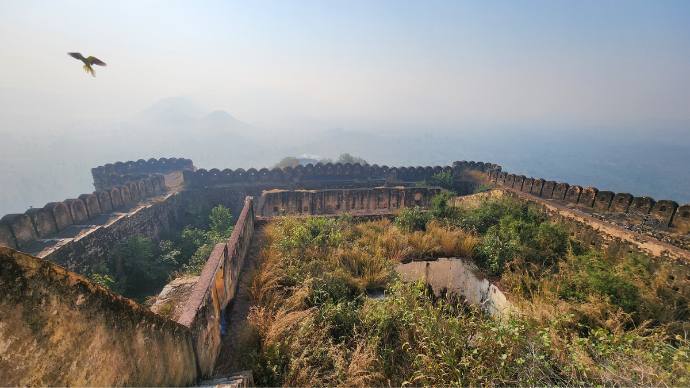
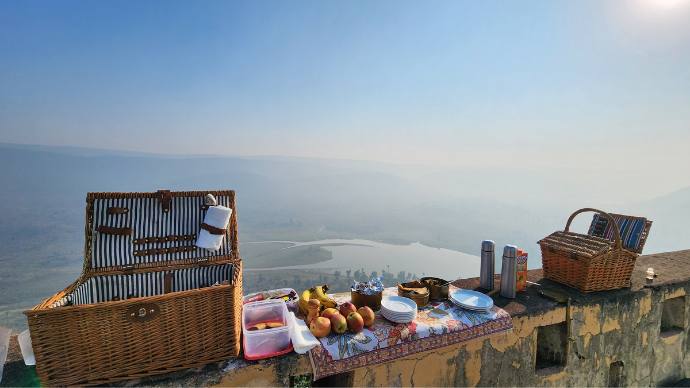
Perched atop a lush hill, the 17th-century fortress is where Mughal emperor Aurangzeb imprisoned his brother DaraShikoh, and later chopped his head off to assert his dominance. The forlorn fort of Kankwari, today, is left unguarded, completely camouflaged with natural vegetation, and has hardly has any visitors. But the view from the top is worth the hike!
Neelkanth Temple
Said to be built gradually between the 6th and 9th centuries, this ancient temple complex is in ruins. Perched high on a plateau within the boundaries of Sariska National Park, a visit to the Neelkanth Temple requires a 40-minute steep drive up a hill deep inside the forest. It is built in the Panchayatana layout: A main shrine is surrounded by four subsidiary shrines, topped with a kalash, chakra, and three canopies.

Legend has it that during their ‘agyaatvas’ (an incognito exile), the Pandavas from the Hindu epic Mahabharata spent their last year in nearby Virat Nagar. Locals believed that they built a temple every day for a year, and there were once 365 shrines in the area!
Chand Baori Stepwell
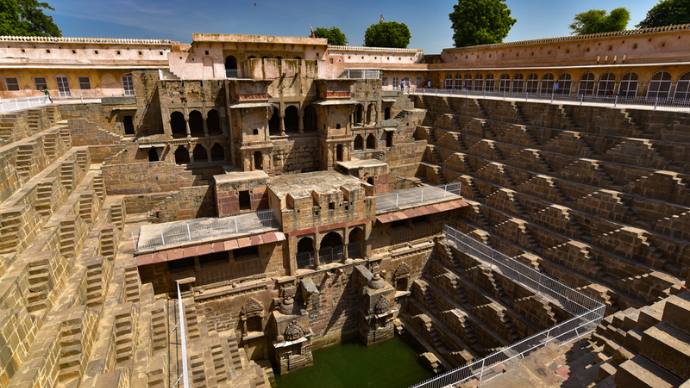
At Abhaneri, a small village at 45 km from the tiger reserve, Chand Baori stands as one of the largest stepwells around the world. Built by Chand Chandra, the then ruler of Nikumbh dynasty somewhere in the 9th century, the ancient stepwell has 3,500 steep steps, 13 levels built with hard sandstone, and an interlocking system construction that looks surreal on a full-moon night!
Where to stay for a ‘RARE’ experience
Utsav Camp Sariska
Base yourself at Utsav Camp Sariska, a peaceful nature retreat set in the Tehla region. A RARE India property, the luxury wildlife lodge is a peaceful sanctuary on the southern side of the Sariska Tiger Reserve, fringed by huge boulders and abundant natural greenery. Utsav Camp Sariska has 20 plush cabins and luxury tents that open out to a grove of fruiting trees, forests, and the Aravalli ranges. The stone cabins feature floor-to-ceiling windows, spacious living rooms, and glass sliding doors that offer panoramic nature views.
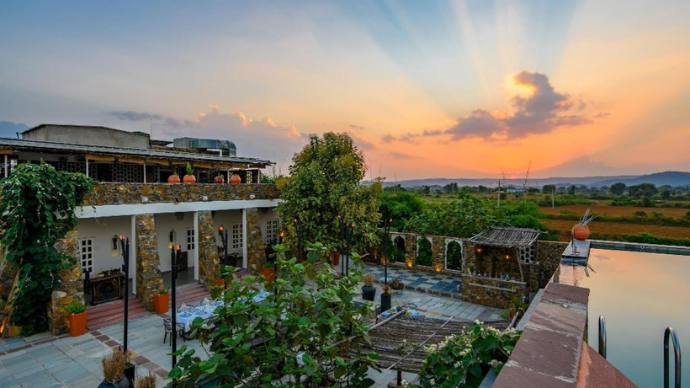

The private outdoor patios come with stargazing beds, and the bathrooms are spacious with beautiful views of the forest through the shower windows. The swiss tents open up to private covered porches where one can wake up each morning naturally to the sounds of birds and the warm glow of the sun.
Camp Kooncha Sariska
If you are looking for a more rustic experience, pick Camp Kooncha Sariska, that promises a wildlife glamping experience in the middle of nowhere. Built on an entirely different concept, this RARE India glamping site is pitched in a secluded re-wilded private estate, nestled between rolling wooded hills. It offers visitors a unique chance to live in the middle of unspoiled wilderness, bordering the tiger reserve, to experience wilderness in exclusivity while camping in luxury.
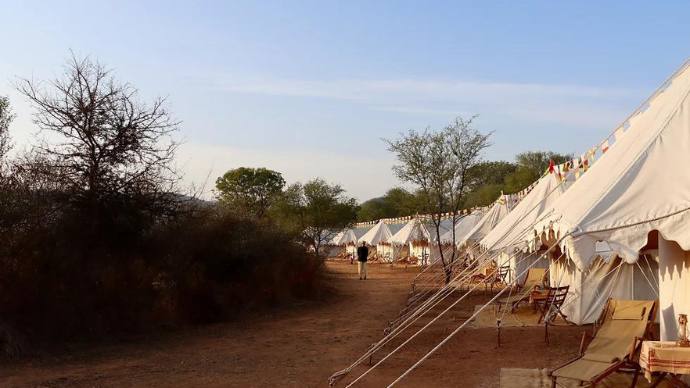

In the fine tradition of the Royal Shikar (Hunting) Camps of Jodhpur, the six tents at Camp Kooncha Sariska are fully furnished in classic Indian Safari Chic and hand-crafted with facilities like open verandahs, sleeper with twin beds, dressers, and an attached bath with toilet, sink, shower, and running, steaming hot water for chilly mornings. Prepare yourself for jungle drives, picnic by the lake, sun-downers with the setting sun, bonfire nights with BBQ and stargazing sessions, village tours, and hiking trails!
Read more.
Survival tale: How the tiger in India’s wild has earned its stripes